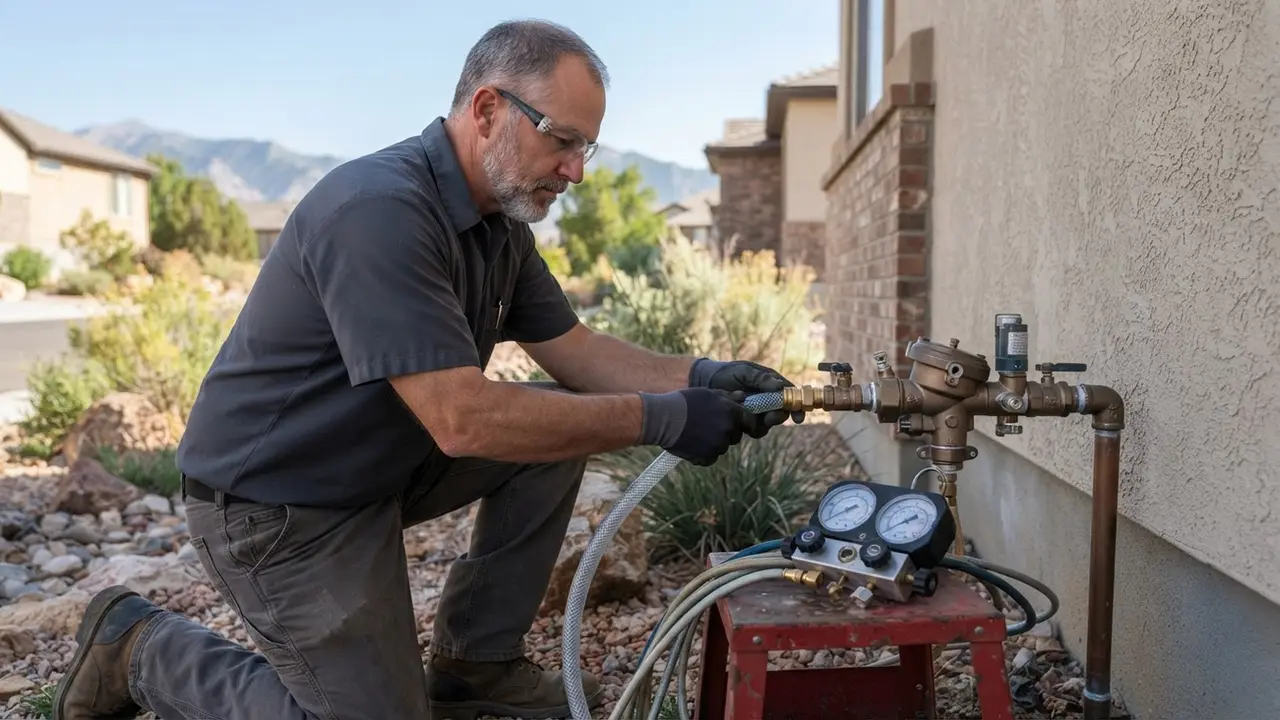
Backflow testing in Utah costs $75 to $150 for most residential assemblies and $150 to $400 for commercial assemblies in 2026. The exact price depends on the assembly type, where it sits on your property, and whether the tester has to file the paperwork with your local water district. Backflow testing is an annual certification required by Utah drinking water regulations that proves your backflow preventer is stopping contaminated water from reversing into the clean supply.
We have tested thousands of assemblies from Ogden down to St. George, and the pricing questions we get are almost always the same. Below is what we actually charge, why the numbers move, and how to avoid the traps that make a cheap test expensive.
What backflow testing actually costs in Utah in 2026
Typical 2026 pricing in Utah for a standard annual backflow test breaks down like this:
- Residential DCVA (double check valve assembly): $75-$110
- Residential RPZ (reduced pressure principle assembly): $95-$150
- Residential PVB (pressure vacuum breaker): $75-$120
- Commercial RPZ or DCVA: $150-$400
- Fire sprinkler backflow assembly: $175-$350
- Irrigation backflow assembly: $75-$140
- After-hours or emergency dispatch: add $75-$150
Most single-family homes in Utah have one assembly, so the annual bill lands between $75 and $150. Commercial properties with two or more assemblies, or a fire line, usually see $300 to $700 total once every device is tested and filed.
If you want a straight answer on your specific assembly, our team handles Backflow Prevention Assembly Testing in Utah and can quote you before we roll a truck. We do not bill for the quote.
Why does backflow testing cost vary in Utah?
Backflow testing prices in Utah vary because the test itself is only part of the job. The rest is travel, paperwork, and the physical layout of your assembly.
Here is what moves the number:
- Assembly type. An RPZ takes longer to test than a DCVA because it has a relief valve that has to be verified separately. That is why RPZ testing costs $20 to $40 more than DCVA testing on the same property.
- Number of assemblies. A building with three devices is not three separate service calls. Most testers discount the second and third assembly by $25 to $50 each.
- Access. An assembly in a clean mechanical room takes 20 minutes. One buried in a vault under a parking lot, or behind a locked gate, can take an hour.
- Travel distance. A tester based in Salt Lake City driving to St. George is adding 300 miles round-trip. That shows up on the invoice.
- Filing fees. Some Utah water districts charge the tester a per-form fee, usually $5 to $15, which gets passed through.
- Season. Spring and early summer are peak season for irrigation backflow testing in Utah. Prices do not usually change, but scheduling gets tighter.
We see this most in older neighborhoods where the assembly was installed decades ago and never updated. Across Backflow Testing in Salt Lake City, for example, a lot of homes still have the original RPZ from the 1980s sitting in a cramped basement corner. Those take longer, and that time is real.
How much does backflow testing cost in Utah for residential properties?
For a single-family home in Utah, budget $75 to $150 per year for one assembly. That covers the test, the gauge work, and the certification form filed with your water district.
What you get for that money:
- A state-certified tester arrives with a calibrated differential gauge.
- The assembly is tested under real pressure to confirm it stops reverse flow.
- Results are recorded on the state-approved form.
- The form is submitted to your city or water district before the deadline.
- You get a copy for your records.
If your assembly fails, the repair is separate. A rebuild kit for a residential RPZ runs $40 to $90 in parts, and labor to install it is usually $75 to $150. A full assembly replacement, if the body is cracked or corroded, runs $200 to $500 installed depending on size and type.
We handle this every day through our Residential Backflow Testing in Utah service. Most homes are in and out in under 30 minutes.
Commercial backflow testing cost in Utah
Commercial backflow testing in Utah runs $150 to $400 per assembly, and most businesses have two or more. A restaurant with a kitchen, a mop sink, and a fire line might have three assemblies and pay $450 to $900 annually.
Commercial pricing is higher for three reasons. The assemblies are larger, the water pressure is higher, and the paperwork is more involved. Some Utah municipalities also require a separate test report for each device, not a combined form.
If you manage a property in West Valley City or West Jordan, the assemblies are often in a shared mechanical room. We test them in one visit and file everything together. Our Commercial Backflow Testing in Utah service is built for property managers who need one invoice and one point of contact.
Fire sprinkler and irrigation backflow testing cost in Utah
Fire sprinkler backflow testing in Utah costs $175 to $350 because the assembly is typically a larger RPZ or a detector check assembly, and the test has to be coordinated with the fire system. We often have to isolate the fire line, test, and restore it the same visit.
Irrigation backflow testing in Utah is on the lower end, $75 to $140, because most irrigation assemblies are PVBs or small DCVAs. The catch is timing. If you blow out your sprinklers in October and forget the backflow test, you may be scrambling in April when the water district sends a notice.
We schedule irrigation tests in early spring before the rush. If you are in Lehi or Draper where irrigation systems are common, book in March. By May, the calendar fills up.
What to watch out for when comparing backflow testing prices
The cheapest quote is not always the cheapest test. Here is what we see go wrong.
- A tester who is not certified for your assembly type. Utah requires certification for each assembly type. A tester certified only for DCVAs cannot legally test your RPZ.
- No filing. Some low-cost testers hand you a form and tell you to file it yourself. If it does not reach the water district by the deadline, you get the violation, not them.
- Uncalibrated gauges. A gauge out of calibration produces a failed test that is not actually a failure. You pay for a repair you did not need.
- Hidden trip charges. A $65 quote that becomes $140 after a $75 trip fee is not a $65 test.
- Pressure to replace. Most failed assemblies need a $50 rebuild kit, not a $400 replacement. Ask what failed and why.
We see this pattern a lot in fast-growing areas. In Backflow Testing in Lehi, new construction means new assemblies, and new assemblies almost never need replacement in year one. If someone tells you otherwise, get a second opinion.
How can I save on backflow testing costs in Utah?
You can cut your backflow testing cost in Utah by bundling assemblies, testing on a regular annual schedule, and handling it before the deadline rush.
What actually works:
- Bundle multiple assemblies. One visit for three devices costs less than three visits.
- Set a calendar reminder. Most Utah water districts require annual testing. A missed deadline can mean a $50 to $200 fine plus a re-test fee.
- Test in the off-season. Late fall and winter are slower. Some testers offer $10 to $25 off for scheduling in January or February.
- Keep your assembly accessible. Clear the vault, unlock the gate, trim the bushes. Access time is billable time.
- Ask about multi-year agreements. Commercial properties with several assemblies can often lock in a flat annual rate.
If you are in South Jordan or Riverton and have both an irrigation assembly and a domestic assembly, we test both in one trip. That is the single easiest way to save $50 or more.
When to call a professional
Call a certified tester when your annual deadline is approaching, when you get a notice from your water district, or when you see water pooling around the assembly. Backflow testing is not a DIY job. It requires a calibrated gauge and a state certification, and the form has to be signed by a certified tester to count.
We handle the test, the filing, and any repair in one visit. If your assembly fails, we tell you what failed, show you the gauge readings, and give you a repair price before we touch anything. No surprise invoices.
If you are not sure whether your assembly is due, call us and we will check your district's records. We do that for free.
Frequently Asked Questions
How much does backflow testing cost in Utah?
Backflow testing in Utah costs $75 to $150 for most residential assemblies and $150 to $400 for commercial assemblies in 2026. The price includes the test and the certification filing. Multiple assemblies on one property are usually discounted $25 to $50 each.
Why does backflow testing cost vary in Utah?
Price varies by assembly type, travel distance, access, and filing fees. An RPZ costs $20 to $40 more to test than a DCVA because it has an extra relief valve. A buried vault or a locked gate adds time, and time is what you are paying for.
Is backflow testing covered by homeowners insurance in Utah?
No. Standard Utah homeowners policies do not cover routine backflow testing because it is a maintenance requirement, not a sudden loss. Some policies may cover water damage caused by a backflow event, but the annual test itself is out of pocket. Budget $75 to $150 per year.
How can I save on backflow testing costs in Utah?
Bundle multiple assemblies into one visit, schedule in the off-season, and keep your assembly accessible. Testing in January or February can save $10 to $25. Commercial properties with three or more assemblies can often negotiate a flat annual rate.
How often do I need backflow testing in Utah?
Utah requires annual backflow testing for most assemblies. Some water districts allow a different schedule for certain device types, but the standard is once every 12 months. Miss the deadline and you may face a fine plus a re-test fee.
Get help with Backflow Testing in Utah
We test, file, and repair backflow assemblies across Utah, and we quote the price before we schedule. If your deadline is coming up, call us at 555 123456 and we will get you on the calendar.