Fire sprinkler backflow testing requirements for Utah businesses come down to one rule: if your building has a fire sprinkler system connected to a public water supply, the backflow preventer on that fire line must be tested every 12 months by a certified tester, and the passing report must be filed with your water supplier. No grace period, no skipping a year because the system never ran. The state's drinking water rules treat a fire line as a direct cross-connection between your building and the municipal main, and that's why the annual test is mandatory rather than optional.
What follows is what we've learned running these tests across Utah - the enforcement chain, what the test actually measures, what it costs in 2026, and the mistakes that get businesses flagged.
Do Utah businesses need annual fire sprinkler backflow testing?
Yes. Utah businesses with fire sprinkler systems need annual backflow testing on every reduced pressure principle assembly (RPZ) or double check valve assembly (DCVA) protecting the fire line. The requirement applies whether you run a warehouse, a restaurant, a dental office, or a 40-unit apartment building. If the fire line ties into culinary water, the assembly gets tested once every 12 months.
The reason is straightforward. Fire sprinkler water sits stagnant in pipes for months or years. When a fire event or a system drain pulls that water backward, whatever is in those pipes - rust, biological growth, glycol from an antifreeze loop - can siphon into the public main. A backflow preventer stops that. The annual test proves the preventer still works.
Utah's rules track the federal Safe Drinking Water Act and the state's cross-connection control program. Most municipal water systems in the state - Salt Lake City, Provo, Ogden, St. George, and the smaller districts in between - adopt the same 12-month cycle. A handful of systems allow a short extension if you file a request before the due date. None of them allow you to simply skip it.
Who enforces fire sprinkler backflow testing in Utah?
Your local water supplier enforces the test, not the state fire marshal and not your city building department. Each municipal water system runs its own cross-connection control program under Utah Administrative Code R309-105, and that program tracks which assemblies are due, receives the test reports, and issues notices when a report is missing.
In practice, enforcement works like this:
- The water supplier mails or emails an annual reminder to the account holder on file.
- You hire a certified tester to perform the test and submit the report.
- If the report doesn't arrive by the deadline, the supplier sends a second notice, then a compliance letter.
- Continued non-compliance can lead to a notice of violation and, in the worst cases, water service termination to the fire line.
That last step is rare but real. We've seen it happen to commercial properties where the owner changed and the reminder letters went to a dead address for two or three cycles. The new owner inherited a shutoff threat and a stack of missed tests.
One more layer: your fire sprinkler contractor handles the system itself - inspections, flow tests, internal piping - under NFPA 25. That's a separate requirement from the backflow test. Don't assume your annual fire inspection covers the backflow assembly. It usually doesn't.
What the test actually involves
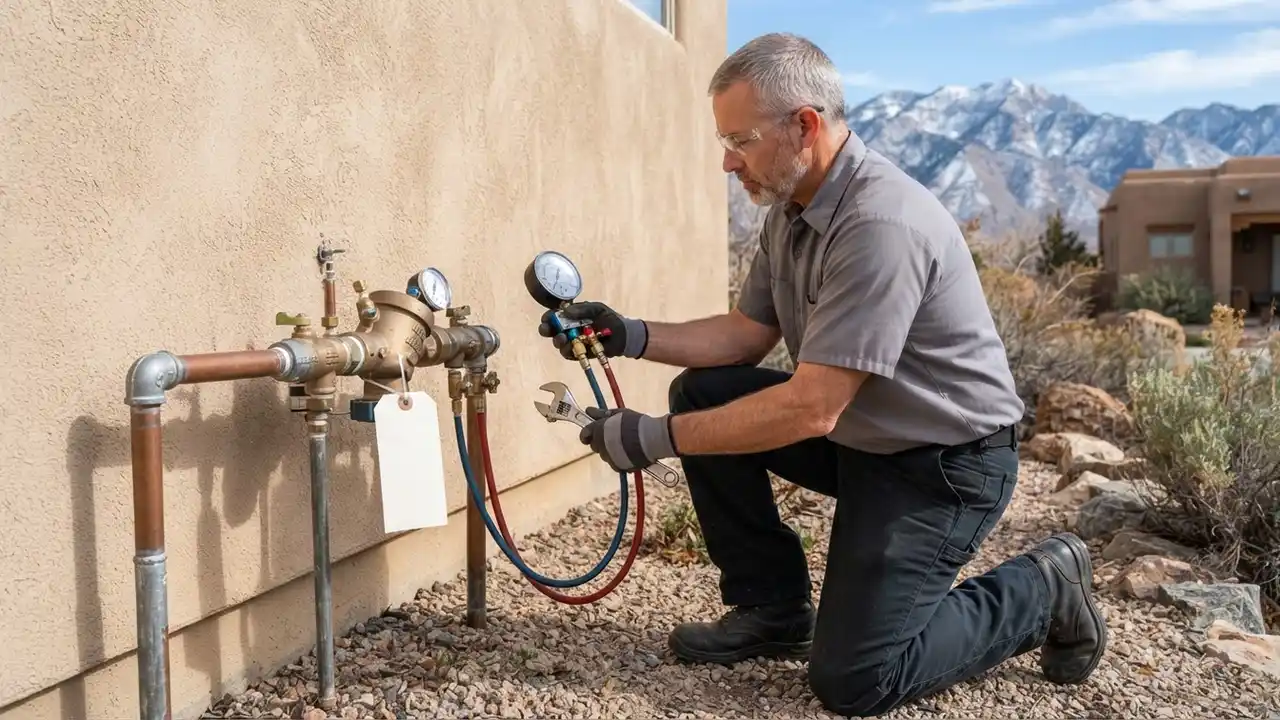
A fire sprinkler backflow test takes 20 to 45 minutes on site and measures whether the assembly's check valves and relief valve hold against backpressure and backsiphonage. The tester connects calibrated gauges to the test cocks, runs a sequence of pressure differential checks, and records the results on the state-accepted form.
Most Utah fire lines use one of two assembly types:
- RPZ (reduced pressure principle assembly) - required where the hazard is high, such as buildings with chemical storage, commercial kitchens, or fire suppression foam systems. RPZs have a relief valve that discharges water during a failure, so the test includes verifying that relief opens at the right differential.
- DCVA (double check valve assembly) - used on lower-hazard fire lines. Two check valves in series, no relief. The test confirms both hold tight.
If your building has a fire pump, the test happens with the pump off and the system static. If you have a dry pipe system, the tester coordinates with your fire contractor so the lines aren't charged during the test. We schedule those around your fire inspection calendar to avoid two trips.
You can see the full breakdown of what each assembly type requires on our page covering fire sprinkler backflow testing Utah businesses rely on for annual compliance.
How often do Utah businesses need fire sprinkler backflow testing?
Every 12 months for standard fire line assemblies. That's the baseline across nearly every Utah water system. A few exceptions exist:
- New installations - tested at installation, then annually on the anniversary of that first test.
- Repaired or replaced assemblies - retested immediately after the repair, then back on the annual cycle.
- High-hazard occupancies - some water systems require testing every 6 months for RPZ assemblies serving certain industrial processes. Check your supplier's cross-connection ordinance.
If you're not sure when your last test was filed, call your water supplier's cross-connection office. They keep the records and can tell you the exact due date. Most will email you a copy of the last report on file.
Fire sprinkler backflow testing cost for Utah businesses
Typical 2026 pricing for fire sprinkler backflow testing in Utah runs $125 to $250 per assembly for a standard annual test, with most single-assembly commercial accounts landing around $150 to $185. That covers the on-site test, the calibrated gauge work, and the report filing.
What moves the number up or down:
- Number of assemblies. A building with one fire line assembly pays the single-assembly rate. A campus with four or five pays less per unit - usually $100 to $140 each.
- Access. If the assembly sits in a vault under the sidewalk or behind a locked mechanical room, expect a modest surcharge for the extra time.
- Repairs. A failed test means parts. A rebuild kit for a 2-inch RPZ runs $80 to $200 in parts, plus labor. A full assembly replacement can run $600 to $1,800 depending on size and brand.
- After-hours scheduling. If your building can't shut down the fire line during business hours, evening or weekend testing adds $50 to $100.
We quote the test fee upfront and tell you the repair cost before we touch anything. No surprise line items on the invoice.
Utah fire sprinkler backflow test report submission
Utah fire sprinkler backflow test report submission is the step most businesses forget, and it's the one that triggers a violation notice. The test itself doesn't satisfy the requirement - the passing report has to reach your water supplier.
Here's how the paperwork flows:
- The certified tester fills out the state-accepted test form with gauge readings, assembly details, and pass/fail status.
- The tester submits the report to the water supplier - most Utah systems now accept digital submission through their portal or by email.
- The supplier logs the test against your account and resets the 12-month clock.
- You get a copy for your records. Keep it. If you sell the building, the buyer's lender will ask for it.
We handle the submission for every test we run. You get a PDF copy by email the same day, and we confirm the supplier received it. If a report gets kicked back for a missing field or an illegible gauge reading, we resubmit at no charge.
One thing to watch: if your water supplier changes, or if your building gets a new account number after a sale, the reminder letters may go to the wrong place. Tell your tester when that happens so the report goes to the right office.
Common mistakes we see on fire line backflow tests
The same handful of problems show up on fire line backflow tests across Utah every year. Fixing them before your due date saves a second trip and a second fee.
- Assuming the fire inspection covers it. NFPA 25 inspections and backflow tests are separate requirements. Your fire contractor may not be certified for backflow, and your backflow tester doesn't inspect the sprinkler heads.
- Letting the assembly sit untested after a repair. A rebuilt RPZ needs a fresh test and a fresh report. The old passing report doesn't cover the new parts.
- Missing the report deadline by a few days. Some suppliers allow a 30-day grace window. Others don't. File early.
- Ignoring a slow drip from the RPZ relief valve. That drip means the relief is passing. It will fail the test, and it's usually a $60 to $120 rebuild kit rather than a new assembly.
- Testing with the fire pump running. The test requires static line pressure. A running pump throws off every reading.
We see this most often in older commercial corridors - the kind of buildings where the fire line was tapped decades ago and the assembly has been in a vault since. If your property is in one of those areas, it's worth a call to Backflow Testing in Salt Lake City or your local supplier to confirm the assembly location before the due date hits.
When to call a professional
Call a certified tester when your annual due date is within 60 days, when you've had a repair on the assembly, or when you're not sure the assembly has ever been tested. We handle the test, the report, and the filing with your water supplier.
Utah Backflow Specialists is a state-certified backflow testing company serving commercial and residential properties across the Wasatch Front and beyond. Our testers carry current certification, calibrated gauges, and the state-accepted forms for every water system we work in. We schedule around your business hours, file the report the same day, and tell you upfront what the test costs and what a repair will cost if the assembly fails.
If you manage multiple properties, we can set up a calendar reminder system so no assembly slips past its anniversary. That's the simplest way to stay out of the violation pile.
Frequently Asked Questions
Do Utah businesses need annual fire sprinkler backflow testing?
Yes. Every fire sprinkler backflow assembly connected to a public water supply in Utah must be tested every 12 months by a certified tester, and the passing report must be filed with your water supplier. There is no exemption for buildings that have never had a fire event.
Who enforces fire sprinkler backflow testing in Utah?
Your local water supplier enforces it through its cross-connection control program under Utah Administrative Code R309-105. The supplier tracks due dates, receives test reports, and issues compliance notices. Continued non-compliance can lead to a notice of violation or water service termination.
How much does fire sprinkler backflow testing cost in Utah?
Typical 2026 pricing runs $125 to $250 per assembly, with most single-assembly commercial accounts paying $150 to $185. Multi-assembly properties often get a per-unit discount. Repairs after a failed test add $80 to $1,800 depending on whether it's a rebuild kit or a full replacement.
What happens if a Utah business skips fire sprinkler backflow testing?
The water supplier sends reminder notices, then a compliance letter, then a notice of violation. In serious cases the supplier can terminate water service to the fire line, which shuts down the building until the test is completed and the report is filed. Insurance carriers may also flag the lapse.
Who can test fire sprinkler backflow preventers in Utah?
Only a tester certified by the state and accepted by your specific water supplier. Certification requires passing an approved exam and maintaining calibrated test gauges. Your fire sprinkler contractor may not hold backflow certification - verify before scheduling.
Get help with Backflow Testing in Utah
If your fire line assembly is due, or you're not sure when it was last tested, we can check the record with your water supplier and get you on the schedule. One test, one report, filed the same day.
Call Utah Backflow Specialists at 555 123456 to book your fire sprinkler backflow test. We serve commercial and residential properties across Utah and file reports with every major water system in the state.