Utah requires most businesses to test their backflow prevention assemblies every 12 months. That annual schedule applies to nearly every commercial property connected to a public water system, from a single espresso cart in Provo to a 40-unit apartment complex in Sandy. Some high-hazard facilities - car washes, dental offices, dry cleaners, and any business handling chemicals - may be placed on a semi-annual or quarterly schedule by their local water purveyor. The rest of this post breaks down the exact code, the reporting deadlines, the 2026 costs, and what happens when a test gets missed.
The Short Answer: Annual Testing for Most Utah Businesses
How often does Utah require backflow testing for businesses? Once every 12 months for standard commercial assemblies, and more often for high-hazard operations. That is the baseline across the state, though each municipal water system enforces its own version of the rule.
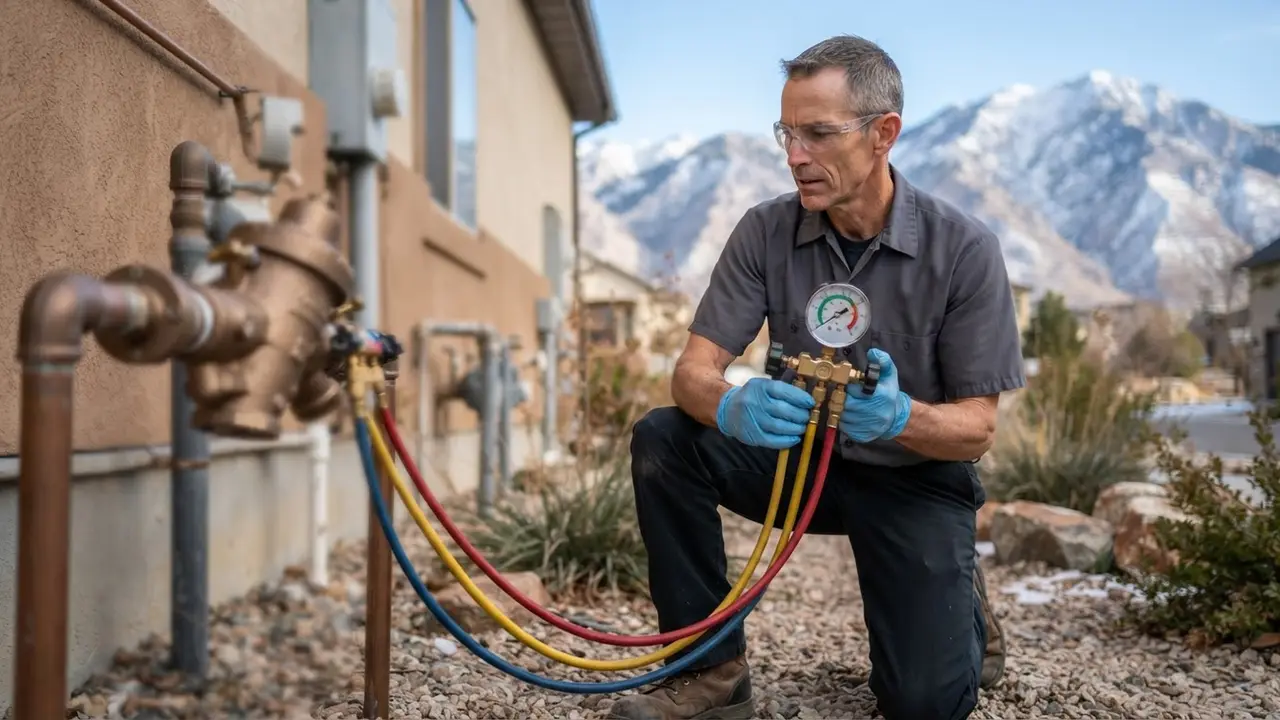
Backflow testing is a procedure where a certified tester uses a differential pressure gauge to confirm that a backflow preventer will stop contaminated water from reversing into the clean supply. The test takes 15 to 30 minutes per assembly and produces a report that goes to your water purveyor.
We run these tests every week for Commercial Backflow Testing in Utah, and the pattern is consistent: a business opens, installs the required assembly, passes the initial test, then forgets about it until a shutoff notice arrives 13 months later. The annual clock starts the day your assembly is installed or the day your last passing test was filed - not on January 1.
Why Utah Requires Annual Backflow Testing
Utah's backflow rules exist because a single cross-connection can contaminate an entire municipal water main. The state adopts the plumbing code through the Division of Professional Licensing and delegates day-to-day enforcement to each water system, which is why Salt Lake City, Ogden, and St. George all have slightly different paperwork even though the testing interval is the same.
The core concern is backpressure and backsiphonage. Backpressure happens when your building's internal pressure exceeds the supply pressure - a boiler, a fire pump, or an irrigation system can cause it. Backsiphonage happens when the main loses pressure during a fire or a main break, and whatever is sitting in your pipes gets pulled backward into the public supply.
Rubber check discs inside a backflow assembly degrade. Heat, chlorine, and constant pressure cycles harden them. A 2026 study from the American Water Works Association found that roughly 8% of assemblies fail their annual test on the first attempt, and that number climbs past 15% for assemblies older than 10 years. Annual testing catches those failures before they become a public health event.
For businesses in older buildings - especially the pre-1980 commercial stock around Backflow Testing in Salt Lake City - we often find assemblies that have never been tested since installation. Those are the ones that fail.
Annual vs. Semi-Annual Backflow Testing in Utah
Annual vs. semi-annual backflow testing in Utah comes down to hazard level, not business size. Your water purveyor assigns the hazard classification when the assembly is registered.
Annual (12-month) testing is the standard for:
- Restaurants and commercial kitchens with grease interceptors
- Office buildings with standard domestic water service
- Retail spaces without chemical processes
- Apartment complexes under 50 units
- Churches, schools, and municipal buildings
Semi-annual (6-month) testing is required for higher-hazard operations:
- Car washes and auto repair shops
- Dental and medical offices with sterilizers
- Dry cleaners and photo labs
- Any facility with chemical injection or boiler treatment
- Large irrigation systems serving more than one parcel
Quarterly testing is rare but does exist for certain industrial processes and for assemblies that have failed twice in a row. If your assembly fails two consecutive annual tests, some purveyors will move you to a 6-month schedule until you pass two in a row.
If you are unsure which schedule applies to your building, the answer is on your water bill or in the letter your purveyor sent when the assembly was registered. We also keep those records for our commercial clients.
Backflow Testing Requirements for Utah Restaurants and Other High-Risk Businesses
Backflow testing requirements for Utah restaurants are the same 12-month interval as other commercial properties, but the assemblies are different. A restaurant typically has three or more backflow preventers: one on the main domestic line, one on the fire sprinkler line, and one on the irrigation system if the property has landscaping.
Each assembly needs its own test and its own report. That means a single restaurant can generate three separate filing deadlines with the same water purveyor.
We see this trip up new restaurant owners constantly. They test the main line, file the report, and assume they are done. Six months later a notice arrives for the fire line assembly they did not know existed. The fire line assembly is usually a Reduced Pressure Principle Assembly RPZ Testing in Utah unit, and it is the one most likely to be missed because it sits in a mechanical room behind the kitchen.
Other high-risk categories with the same multi-assembly problem include:
- Hotels with laundry facilities and pools
- Hospitals and surgery centers
- Golf courses with fertigation systems
- Manufacturing plants with process water
If your business falls into any of these, count your assemblies before you count your deadlines.
Who Enforces Backflow Testing for Businesses in Utah?
Who enforces backflow testing for businesses in Utah? Your local water purveyor - the city or water district that sells you water - not the state health department. The state sets the plumbing code, but each purveyor runs its own cross-connection control program.
That means the enforcement office for a business in Backflow Testing in West Jordan is the West Jordan water department, while a business two miles away in South Jordan answers to a different office with a different filing portal.
Enforcement tools available to purveyors include:
- Written notices with a compliance deadline (usually 30 days)
- Second notices with a shorter window (10 to 15 days)
- Water service termination for repeated non-compliance
- Fines in some jurisdictions, typically $50 to $250 per month of non-compliance
Most purveyors would rather help you get compliant than shut off your water. But they will shut it off. We have seen it happen to a restaurant in Layton that ignored three notices and lost water service on a Friday afternoon.
How Are Utah Backflow Test Reports Submitted?
How are Utah backflow test reports submitted? Your certified tester files the report directly with your water purveyor, usually within 10 business days of the test. You should receive a copy for your records.
Submission methods vary by purveyor:
- Online portal - most larger systems (Salt Lake City, West Valley City, Provo) use an online form or a third-party platform
- Email - smaller districts accept a scanned PDF on the purveyor's form
- Mail - a few rural systems still want a paper copy
The report must include the assembly make, model, size, serial number, test gauge readings, and the tester's certification number. If any of those are missing, the purveyor rejects the report and the clock keeps running.
We handle the filing for every test we perform. You get a copy by email the same day, and we keep the record on file so next year's reminder goes out automatically.
What Happens If a Utah Business Misses Backflow Testing?
What happens if a Utah business misses backflow testing? The first consequence is a notice from your purveyor, usually within 30 days of the missed deadline. Ignore that and the consequences escalate quickly.
The typical escalation path looks like this:
- Day 1-30 past deadline: First notice, 30-day compliance window
- Day 31-45: Second notice, 10 to 15-day window, sometimes a fine
- Day 46-60: Final notice with a shutoff date
- Day 61+: Water service terminated until a passing test is filed
For a restaurant, losing water service means closing. For an apartment building, it means tenants without water and a call to the health department. For a dental office, it means cancelling every appointment on the schedule.
The cost of a late test is trivial compared to the cost of a shutoff. A standard annual test in 2026 runs $75 to $150 per assembly in most Utah markets. A shutoff and reconnection can cost $500 or more in fees, plus the revenue you lose while the water is off.
Common Mistakes Utah Businesses Make with Backflow Testing
The most common mistake is assuming the test is a one-time requirement. It is not. The assembly that passed in 2024 needs to be tested again in 2025, 2026, and every year after that for the life of the building.
Other mistakes we see regularly:
- Testing only the main line. Fire lines, irrigation lines, and boiler feeds each have their own assembly and their own deadline.
- Using an uncertified tester. Utah requires testers to hold current certification. A report from an uncertified tester is rejected, and you have not complied.
- Missing the filing deadline. The test date and the filing date are different. A test performed on day 360 but filed on day 375 is late.
- Ignoring the reminder letter. Purveyors send reminders 30 to 60 days before the deadline. Those letters are not optional reading.
- Assuming a new assembly is exempt. New assemblies must be tested at installation and then annually. There is no grace period.
We also see businesses that move or renovate and forget to update their assembly registration with the purveyor. If the purveyor does not know the assembly exists, they cannot remind you - and they will find out eventually.
When to Call a Professional
Call a certified tester when your annual deadline is within 60 days, when you receive any notice from your water purveyor, or when you are not sure how many assemblies your building has. We handle the test, the paperwork, and the filing so you do not have to track multiple deadlines across multiple assemblies.
Utah Backflow Specialists works with commercial properties across the Wasatch Front and beyond. We keep your assembly records, send reminders before your deadline, and file the report the same day we test. If you have never had your assemblies tested, we can start with an inventory and get you on a schedule.
Frequently Asked Questions
How often does Utah require backflow testing for businesses?
Utah requires annual backflow testing for most businesses - every 12 months from your last passing test. High-hazard facilities like car washes, dental offices, and dry cleaners may be placed on a 6-month or quarterly schedule by their local water purveyor.
Do all Utah businesses need annual backflow testing?
Any business connected to a public water system with a backflow prevention assembly must test it annually. If your building has a fire sprinkler system, irrigation system, or boiler, you likely have multiple assemblies, each requiring its own annual test and report.
Who enforces backflow testing for businesses in Utah?
Your local water purveyor enforces backflow testing, not the state health department. Each city or water district runs its own cross-connection control program with its own deadlines, forms, and penalties for non-compliance.
How are Utah backflow test reports submitted?
Your certified tester submits the report directly to your water purveyor, usually within 10 business days. Most larger systems use an online portal; smaller districts accept email or mail. You receive a copy for your records.
What happens if a Utah business misses backflow testing?
You receive a notice with a 30-day compliance window. Ignore it and you may face fines of $50 to $250 per month and eventual water service termination. A standard test costs $75 to $150 per assembly - far less than a shutoff.
Get Help with Backflow Testing in Utah
If your annual deadline is approaching or you are not sure which assemblies your building has, we can help. We test, file, and track every assembly so you stay compliant without the guesswork.
Call Utah Backflow Specialists at 555 123456 to schedule your commercial backflow testing.