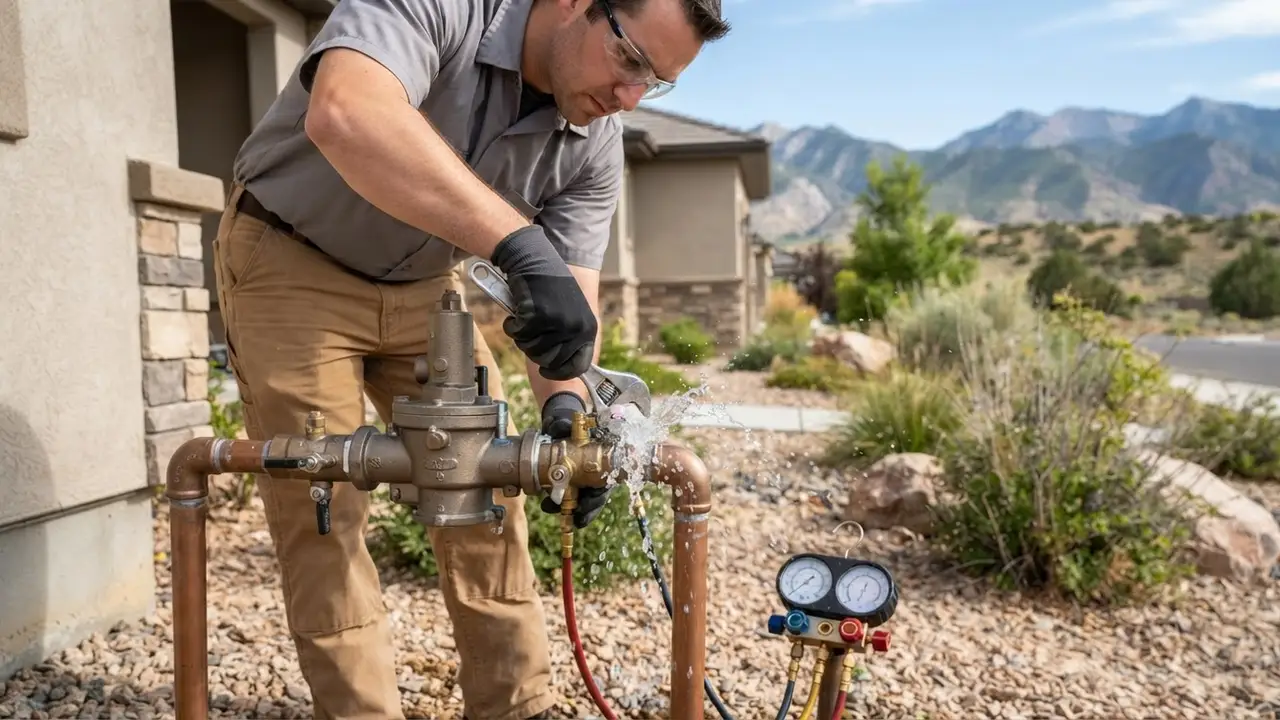
Finding a certified backflow tester in Salt Lake City means confirming three things before you book: the tester holds a current Utah backflow assembly tester certification, they carry the gauges and fittings for your specific assembly type, and they file the test report with your water purveyor. Skip any one of those and you can end up paying twice - once for a test that does not count and again for the one that does.
Most residential tests in the Salt Lake Valley run $75 to $150 in 2026, take 20 to 40 minutes on site, and are required annually by the Salt Lake City Department of Public Utilities and most surrounding water districts. This guide walks through how to verify a tester's credentials, what to ask before they show up, what pricing looks like across the valley, and the mistakes that cost homeowners and property managers the most time.
What a Certified Backflow Tester Actually Does
A certified backflow tester is a state-credentialed technician who tests mechanical backflow prevention assemblies to confirm they stop contaminated water from reversing into the public drinking water supply. In Utah, that credential is issued through the Division of Drinking Water after the tester passes an approved certification course and an exam, and it has to be renewed on a set cycle.
The job is more than hooking up a gauge and reading a number. On a typical residential call, the tester:
- Shuts off the downstream isolation valve and confirms the assembly holds against city pressure
- Connects a differential pressure gauge to the test cocks and records the actual readings
- Checks each check valve and the relief valve independently, comparing results to the manufacturer's pass thresholds
- Tags the assembly with the test date and tester ID
- Files the test report with the water purveyor, usually within a few business days
If the assembly fails, the tester has to document why - a fouled check valve seat, a relief valve opening below the threshold, a cracked body - and either repair it on the spot or schedule a return visit. That distinction matters because a failed test that never gets corrected can trigger a shutoff notice from the city.
We handle Backflow Prevention Assembly Testing in Utah for every common assembly type in the valley, from the RPZ devices on commercial boiler lines to the small DCVAs on residential irrigation. Knowing which assembly you have before you call saves a trip.
How Do I Find a Certified Backflow Tester in Salt Lake City?
You find a certified backflow tester in Salt Lake City by starting with your water purveyor's approved tester list, then cross-checking the tester's Utah certification status and their experience with your specific assembly. Salt Lake City Public Utilities, Sandy, West Jordan, West Valley City, and most other valley municipalities each maintain their own approved list, and a tester who is approved in one city is not automatically approved in the next.
Here is the order that saves the most time:
- Pull your last test report or look at the tag on the assembly. It lists the assembly type, size, make, and model.
- Call your water purveyor or check their website for the current approved tester list.
- Confirm the tester is certified for that specific assembly type - an RPZ tester is not automatically certified on a PVB or SVB.
- Ask whether they file the report electronically with your purveyor or hand you a paper copy to submit yourself.
Most homeowners in the valley are on a Salt Lake City Public Utilities account, and their approved list is the fastest filter. If you are in one of the surrounding cities, the process is the same but the list is different. We run Backflow Testing in Salt Lake City and the surrounding municipalities, and we keep current approvals on file for each purveyor we serve.
One thing to know: many property management companies and HOAs have a preferred tester already on file. If you are a tenant or a new owner, ask the manager before you book - it can save you a duplicate test fee.
How to Verify a Backflow Tester License in Utah
You verify a backflow tester license in Utah by checking the tester's certification number against the Division of Drinking Water's records and confirming the certification is current, not expired. Utah does not issue a general "backflow license" - it issues a certification tied to the individual tester, and that certification has to be renewed.
Ask for the certification number and the expiration date. Then verify it. The Division of Drinking Water maintains a searchable record of certified backflow assembly testers, and a legitimate tester will hand the number over without hesitation. If someone dodges the question or says the number is "on the truck," that is a red flag.
Two more checks worth doing:
- Insurance. Ask for a certificate of insurance. A tester working on your property without liability coverage is a risk you do not want to carry.
- Gauge calibration. Differential pressure gauges have to be calibrated annually. Ask when theirs was last calibrated - an out-of-calibration gauge can produce a failed reading that is not real.
If you are hiring for a commercial property, the bar is higher. Commercial assemblies are often larger, higher-pressure, and tied to fire suppression or process water systems. We handle Commercial Backflow Testing in Utah for property managers, and the verification steps are the same - we just bring the right gauges and the right paperwork for the assembly on site.
What Should I Ask a Backflow Tester in Salt Lake City Utah?
Ask a backflow tester in Salt Lake City Utah five questions before you book: their certification number and expiration, their experience with your assembly type, whether they file the report with your purveyor, what the test costs if the assembly fails, and how soon they can get there. The answers tell you more than any review score.
The full list we recommend:
- What is your Utah backflow tester certification number, and when does it expire?
- Have you tested this specific assembly make and model before?
- Do you file the test report with my water purveyor, or do I have to?
- What does a failed test cost, and what does a repair cost if the assembly needs one?
- How soon can you get out here, and do you charge a trip fee?
Question four is the one most people forget. A tester who quotes $85 for the test but $250 for a repair that turns out to be a five-minute check valve swap is not being dishonest - but you should know the number before you agree. Ask for the repair rate up front.
Question five matters more than people expect. Annual testing deadlines cluster in spring and early summer, and same-day backflow testing in Salt Lake City gets tight in April and May. If you are calling in March, you have options. If you are calling on the 28th of the month your notice is due, you take whoever can get there.
How Much Does Backflow Testing Cost in Salt Lake City?
Typical 2026 pricing in the Salt Lake City area runs $75 to $150 for a residential backflow test and $150 to $400 for commercial assemblies, depending on assembly size and type. The test itself is the cheap part. Repairs are where the bill moves.
Here is what we see across the valley:
- Residential DCVA or PVB test: $75-$125
- Residential RPZ test: $100-$150
- Commercial RPZ or reduced pressure detector assembly: $150-$400
- Fire line backflow test: $200-$500, higher for detector assemblies with multiple test ports
- Common repairs: $50-$200 for a check valve or relief valve rebuild kit, $300-$900 to replace a failed assembly body
Two things drive the price up. First, assembly size - a 2-inch RPZ takes longer to test than a 3/4-inch DCVA. Second, access. If your assembly is buried in a vault, behind a locked gate, or in a mechanical room that requires an escort, expect a higher quote.
If you are shopping on price alone, ask what is included. A $60 test that does not include filing the report with the city is not a $60 test - it is a $60 test plus your afternoon at the public utilities office. We quote the test, the filing, and any repair separately so you see the whole number before we start.
For homeowners specifically, we run Residential Backflow Testing in Utah with the same pricing structure across the valley. No surprise line items on the invoice.
Common Mistakes When Hiring a Backflow Tester
The most common mistake is hiring on price alone and ending up with a test that does not satisfy the water purveyor. The second most common is waiting until the notice arrives to book. Here are the ones we see repeatedly.
- Not checking the purveyor's approved list. A tester certified in Utah but not approved by your specific city can test your assembly and still leave you non-compliant.
- Assuming all testers handle all assembly types. RPZ, DCVA, PVB, SVB, and AVB assemblies each have their own test procedure and pass criteria. Ask.
- Ignoring the tag. The tag on your assembly tells the tester everything they need to bring. Photograph it before you call.
- Booking the day the notice is due. Same-day slots exist, but they fill fast in spring. Book two to three weeks ahead of your deadline.
- Not keeping the report. Keep the test report for at least three years. If the city questions your compliance, the paper trail is your proof.
- Letting a failed assembly sit. A failed test is not a suggestion. It is a notice that the assembly is not doing its job. Get it repaired and retested.
One more: do not assume the tester who did your neighbor's house is approved for yours. Water purveyor boundaries in the Salt Lake Valley do not follow neighborhood lines. A house two streets over can be on a different system with a different approved list.
When to Call a Professional
Call a professional tester the moment you receive a testing notice, notice water backing up at a fixture, or see a backflow assembly that has not been tested in over a year. Backflow assemblies do not fail loudly. They fail quietly, and the first sign is usually a notice from the city or a failed test.
Signs you should not wait:
- You received a compliance notice with a deadline
- Your assembly tag shows a test date older than 12 months
- You see water pooling around the assembly or a vault that stays wet
- You smell or taste something off in the water after a main break in your area
- You are selling the house and the buyer's inspector flagged the assembly
Our team handles the test, the filing, and any repair in one visit when the assembly needs it. We carry common rebuild kits on the truck for the assembly types we see most in the valley, so most repairs are done the same day. If you are in one of the surrounding cities, we also run Backflow Testing in West Jordan and the rest of the south valley on the same schedule.
Frequently Asked Questions
How do I find a certified backflow tester in Salt Lake City?
Start with your water purveyor's approved tester list, then confirm the tester's Utah certification number and expiration date. Salt Lake City Public Utilities, Sandy, West Jordan, and West Valley City each keep their own lists, so verify the tester is approved for your specific city before booking.
What should I ask a backflow tester in Salt Lake City Utah?
Ask for their certification number and expiration, their experience with your assembly type, whether they file the report with your purveyor, what a failed test and repair cost, and how soon they can come out. Get the repair rate up front so there are no surprises on the invoice.
How much does backflow testing cost in Salt Lake City?
Residential tests run $75 to $150 in 2026. Commercial assemblies run $150 to $400, and fire line tests run $200 to $500. Repairs add $50 to $200 for common rebuilds and $300 to $900 for full assembly replacement. Filing with the city is usually included.
Are backflow testers licensed in Utah?
Utah certifies backflow assembly testers through the Division of Drinking Water. The certification is tied to the individual tester, must be renewed on a set cycle, and can be verified against state records. Ask for the certification number and expiration date before you book.
How often does a backflow assembly need to be tested in Utah?
Most assemblies in Utah require annual testing. Some high-hazard commercial and fire line assemblies are tested more frequently. Your water purveyor sets the schedule, and the notice you receive from them is the deadline that matters. Keep the test report for at least three years.
Get Help with Backflow Testing in Salt Lake City
If your testing notice is sitting on the counter and the deadline is closing in, we can get a certified tester to your property, run the test, file the report with your purveyor, and handle any repair the same day. Call Utah Backflow Specialists at 555 123456 and we will confirm your assembly type and get you on the schedule.