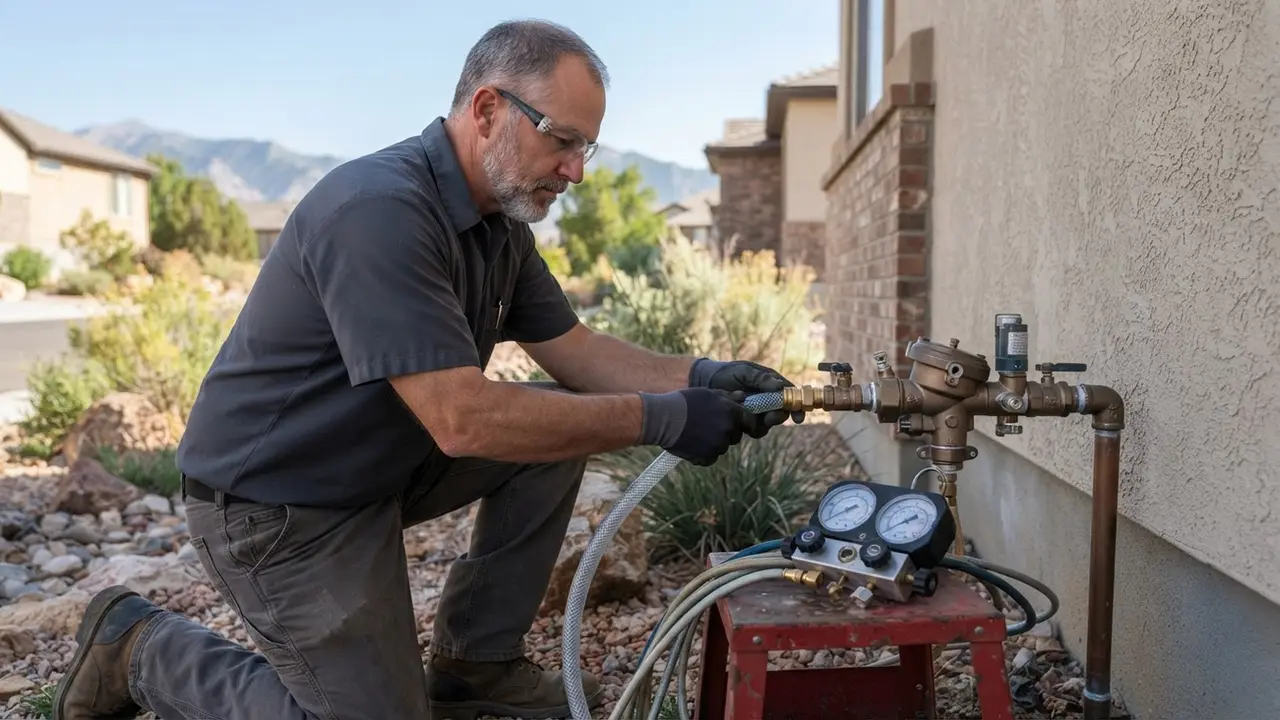
Your Utah backflow test report is a one-page document that shows whether your backflow prevention assembly passed or failed its annual certification test, along with the specific pressure readings that prove it. If you see a "Passed" or "Failed" checkbox, the assembly type, the serial number, and a certified tester's signature, you have everything you need to understand your compliance status.
Most homeowners and property managers in Utah get this report once a year and file it without reading it closely. That is a mistake. The report tells you exactly what condition your backflow assembly is in, when the next test is due, and whether your water district has what it needs to keep your account in good standing.
This guide walks through every field on a Utah backflow test report, explains what pass and fail results actually mean, and covers how reports get submitted to water districts across the state. We do this work every day through our Backflow Testing in Utah, and we have seen how confusing these forms can look the first time.
What a Utah backflow test report actually contains
A Utah backflow test report is a standardized form that a certified tester fills out on-site after testing your backflow prevention assembly. It documents the assembly type, the test procedure used, the pressure readings recorded, and whether the assembly meets state and local requirements.
Here is what you will find on almost every report used in Utah:
- Property information - service address, owner name, and sometimes the water account number
- Assembly details - manufacturer, model, size, and serial number
- Assembly type - RPZ, DCVA, PVB, SVB, or AVB
- Test date - the day the test was performed
- Test results - pass or fail, with individual check valve and relief valve readings
- Tester information - name, certification number, and signature
- Next test due date - usually 12 months from the test date
The assembly type matters because different assemblies are tested differently. An RPZ assembly has a relief valve that must open at a specific pressure, while a double check valve assembly does not. If your report shows an RPZ but your building actually has a DCVA, that is a paperwork error worth correcting before you submit anything.
We test all five assembly types across the state, including Reduced Pressure Principle Assembly RPZ Testing in Utah for commercial buildings and irrigation systems that require the highest level of protection.
How to read the test results section
The test results section is where the actual numbers live, and it is the part most people skip. Those numbers tell you whether your assembly is holding pressure correctly or barely passing.
For an RPZ assembly, you will see three key readings:
- Relief valve opening point - must open at 2.0 psi or higher. If it opens below that, the assembly fails.
- Check valve #1 differential - must hold at least 5.0 psi. This is the primary check valve.
- Check valve #2 differential - must hold at least 1.0 psi. This is the secondary check valve.
For a DCVA, you will see two readings: check valve #1 and check valve #2, both of which must hold at least 1.0 psi. There is no relief valve on a DCVA, so no relief valve reading appears.
For a PVB or SVB, the critical reading is the air inlet opening point, which must open at 1.0 psi or higher. An AVB has a similar air inlet requirement but is tested differently and cannot be tested under continuous pressure.
If any single reading falls below the minimum, the assembly fails. There is no partial pass. A report that shows "Passed" means every reading met or exceeded the threshold on the day of the test.
One thing to watch: a reading that barely passes, like a check valve differential of 1.1 psi when the minimum is 1.0 psi, tells you the assembly is close to failing. We flag those for customers so they can plan for repair or replacement before next year's test.
What does a passed backflow test report look like in Utah?
A passed backflow test report in Utah shows a "Passed" or "Compliant" status, all pressure readings at or above the minimum thresholds, and a tester signature with a valid certification number. The report also includes the next test due date, which is 12 months from the test date.
When we hand a customer a passed report, here is what they see:
- A clear pass indicator at the top or in the results section
- Every reading above the minimum - no red flags
- The tester's Utah certification number, which you can verify with the state
- A test tag attached to the assembly with the test date and tester name
- A copy for your records and a copy that goes to the water district
A passed report does not mean the assembly will pass next year. Backflow assemblies wear out. Rubber seals degrade, springs lose tension, and debris from the water supply can foul check valves. That is why the state requires annual testing rather than testing every three or five years.
If your assembly is in a high-use application, like a commercial fire sprinkler system or a large irrigation system, we sometimes recommend testing more frequently than the annual minimum. The cost of an extra test is far less than the cost of a failed inspection or a cross-connection incident.
What does a failed backflow test report mean in Utah?
A failed backflow test report in Utah means one or more pressure readings fell below the minimum threshold, and the assembly is not providing adequate protection against backflow. You have a limited window to repair or replace the assembly and retest before your water district flags your account.
Most Utah water districts give you 30 days from the failed test to complete repairs and submit a passing retest report. Some districts are stricter and require action within 10 to 15 days. If you miss that window, the district can shut off water service to the property until the assembly passes.
Common reasons an assembly fails:
- Debris lodged in a check valve seat
- Worn or hardened rubber seals
- Broken or weakened springs
- Corrosion inside the valve body
- Freeze damage from a hard winter
- Physical damage to the assembly
Some failures are simple fixes. A check valve that fails because of debris can often be cleaned and retested the same day. Others require replacing the entire assembly, which means ordering parts and scheduling a return visit.
When we test an assembly and it fails, we tell the customer immediately, explain what failed, and give them a repair estimate on the spot. No waiting for a follow-up call.
Understanding your backflow test tag
A backflow test tag in Utah is a physical tag attached to the assembly after testing, showing the test date, the tester's name and certification number, and the pass or fail result. It is separate from the paper or digital report but contains the same core information.
Water district inspectors look for the tag during site visits. If the tag is missing, damaged, or shows an expired test date, the inspector will flag the property even if a passing report was submitted.
Tags get damaged by weather, painted over during building maintenance, or removed by someone who did not know what they were. If your tag is missing, call your tester and ask for a replacement. We re-tag assemblies for customers at no charge when the original tag is lost or damaged.
The tag is not a substitute for the report. Water districts want the full report with pressure readings on file. The tag is just a quick visual reference for inspectors and for you.
Utah backflow test report submission requirements
Utah backflow test report submission requirements vary by water district, but most districts require the certified tester to submit the report directly within 10 to 30 days of the test. In most cases, the tester submits the report, not the property owner.
Here is how submission typically works:
- The tester completes the test on-site and fills out the report
- The tester submits the report to the water district by email, online portal, or mail
- The district reviews the report and updates the property's compliance record
- The property owner receives a copy for their records
Some districts in Utah use an online portal where testers upload reports directly. Others still accept email or paper submissions. The method depends on which district serves your property.
If you are not sure whether your report was submitted, call your water district and ask for your backflow compliance status. They can tell you whether they have a current report on file and when the next test is due.
We handle submission for every test we perform. Our customers do not have to chase down paperwork or wonder whether the district received the report. We submit it and confirm it was accepted.
For commercial properties with multiple assemblies, we track every test date and submit reports to the correct district for each assembly. A single commercial building can have three or four assemblies, each with its own test schedule and compliance record.
Common mistakes when reading your report
The biggest mistake is assuming a passed report means you are done for the year. You still need to confirm the report was submitted to your water district and that the district accepted it.
Other mistakes we see:
- Not checking the assembly serial number - if the serial number on the report does not match the assembly on your property, the report is for the wrong assembly
- Ignoring a barely-passing reading - a reading that barely passes today will likely fail next year
- Filing the report without noting the next test date - mark your calendar 11 months out so you have time to schedule
- Assuming the tag is enough - the tag does not replace the report on file with the district
- Not keeping a copy - keep your copy for at least three years in case of a dispute or audit
We see these mistakes most often in areas with a lot of older housing stock and rental properties, like Backflow Testing in Salt Lake City, where properties change hands and records get lost. If you inherit a property and cannot find the last test report, call the water district first. They usually have a record of the last test on file.
When to call a professional
Call a certified backflow tester if your report shows a failed result, if you cannot find your last report, or if your next test date is within 60 days. Testing requires calibrated gauges and a state certification that most property owners do not have.
We test all assembly types and handle submission to every water district along the Wasatch Front and beyond. If you have a failed report sitting on your desk, call us. We will tell you what failed, what it takes to fix it, and how quickly we can get a passing retest on file.
We also work with property managers who need to track multiple assemblies across multiple buildings. One call, one schedule, one point of contact for every test.
Frequently Asked Questions
How do I read my Utah backflow test report?
Look for the pass or fail status first, then check the pressure readings against the minimum thresholds for your assembly type. RPZ assemblies need a relief valve reading of 2.0 psi or higher and check valve readings of 5.0 psi and 1.0 psi. DCVAs need both check valves at 1.0 psi or higher.
What does a failed backflow test report mean in Utah?
A failed report means one or more readings fell below the minimum, and the assembly is not protecting your water supply. Most Utah districts give you 30 days to repair and retest. Miss that window and the district can shut off your water.
How are Utah backflow test reports submitted to the water district?
In most Utah districts, the certified tester submits the report directly by email, online portal, or mail within 10 to 30 days of the test. Property owners receive a copy but usually do not submit the report themselves.
How long do I keep my Utah backflow test report?
Keep your copy for at least three years. Water districts typically maintain their own records, but having your own copies helps if you sell the property, dispute a compliance flag, or need to prove testing history during an audit.
How long are Utah backflow test reports valid?
Utah backflow test reports are valid for 12 months from the test date. The next test is due on the anniversary of the last passing test. Some high-risk applications may require more frequent testing.
Get help with Backflow Testing in Utah
If your report shows a failure, your test date is coming up, or you just want someone to handle the paperwork and submission for you, we can help. We test, repair, retest, and submit - all in one visit when possible.
Call Utah Backflow Specialists at 555 123456 to schedule your test or ask questions about your current report.