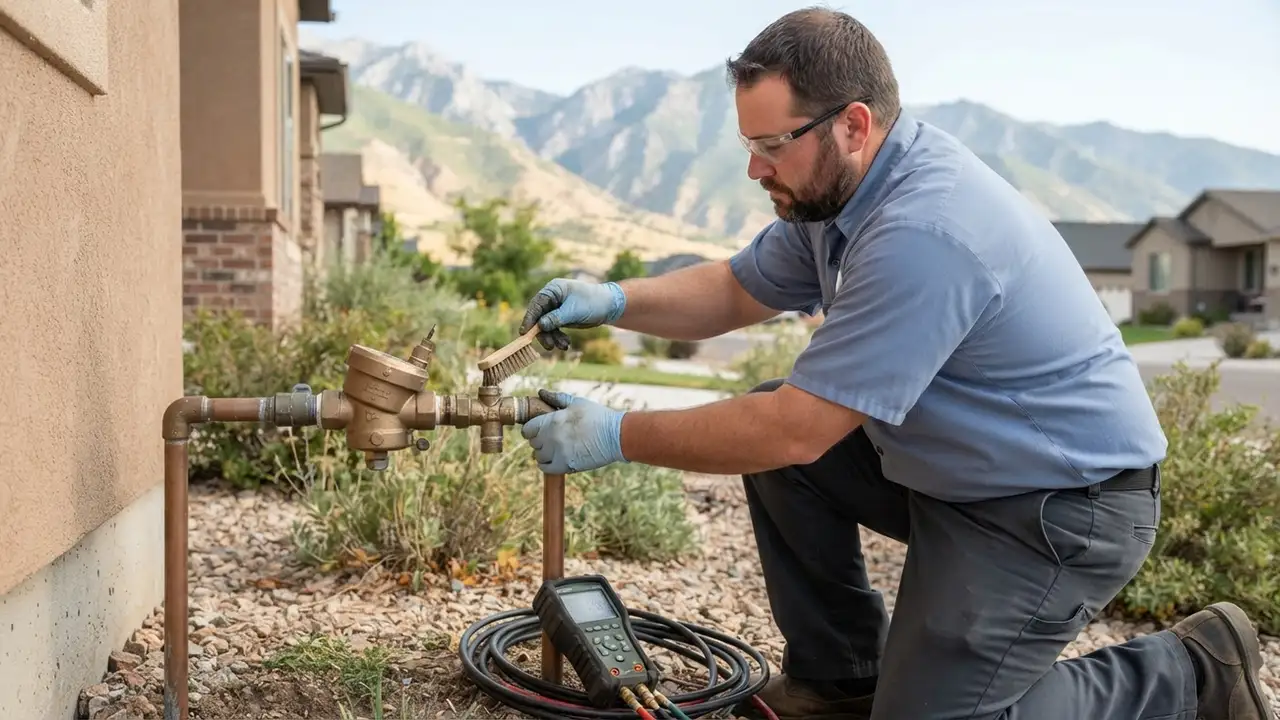
Residential backflow testing in Provo is an annual or semi-annual inspection of the mechanical assembly that keeps contaminated water from reversing into your home's drinking supply. If your house has a sprinkler system, a boiler, a pool, or any cross-connection to the city main, Provo City requires a certified test - usually once a year - and the results must be filed with the water department. This post covers who needs it, how often, what it costs in 2026, and what happens on test day.
What residential backflow testing actually is
Residential backflow testing is a procedure that verifies a backflow prevention assembly - most often a reduced pressure principle (RPZ) or double check valve (DCVA) - is mechanically sound and will stop water from flowing backward under real pressure conditions. A certified tester connects a gauge kit to the assembly's test ports, opens and closes the valves in a specific sequence, and records the pressure differentials. If the numbers fall outside the state code thresholds, the assembly fails and must be repaired or replaced.
Backflow itself is simple physics. Water normally flows from the city main into your house because the main is at higher pressure. If that pressure drops - a water main break, a fire hydrant opened hard, a nearby construction crew hitting a line - the pressure gradient can flip. Water sitting in your irrigation lines, boiler, or pool plumbing can get pulled backward into the main. That water may carry fertilizer, dog waste, pool chemicals, or bacteria. A working backflow assembly is the only thing standing between that water and your kitchen tap.
Does my Provo home need backflow testing?
Your Provo home needs backflow testing if it has any cross-connection to the public water supply - and most homes with automatic sprinklers, a boiler-based heating system, a pool, or a fire sprinkler line do. Provo City's cross-connection control program requires an approved assembly and a passing test on file for those properties. A plain house with no irrigation and no auxiliary water system usually does not need one.
Here is the practical checklist we run through with Provo homeowners:
- In-ground sprinkler system: almost always requires an RPZ or PVB assembly and annual testing.
- Boiler or hydronic heating: often requires a DCVA or RPZ depending on the chemical treatment used.
- Swimming pool or hot tub with auto-fill: typically requires an RPZ.
- Fire sprinkler line (residential): requires a dedicated assembly and annual test.
- Plain home, no irrigation, no auxiliary water: usually no assembly required.
If you are not sure which category you fall into, the assembly itself is the giveaway. Look for a brass or bronze device on the incoming water line or the irrigation stub-out, usually near the meter or the side of the house. If you see one, the city expects a test record for it.
How often does Provo require home backflow testing?
Provo requires home backflow testing once every 12 months for most residential assemblies, with a small number of high-hazard setups - typically those tied to chemical injection or dedicated fire lines - tested every six months. The city sends a notice when your test is due, and you have a limited window to file the results before the account is flagged.
Two things trip people up. First, the clock runs from the last passing test date, not from the calendar year. If your test was done in March 2025, your next one is due by March 2026. Second, the test has to be performed by a tester certified by the Utah Division of Drinking Water and filed through the city's portal. A test done by an uncertified handyman does not count, even if the assembly passes.
If you miss the deadline, Provo can issue a notice of violation and, in repeat cases, shut off irrigation service until a passing test is on file. That is a bad week in July. We schedule most of our Provo residential tests in the spring, before the irrigation season ramps up, so the paperwork is done before the first hot stretch.
What happens during a residential backflow test
A residential backflow test takes 20 to 40 minutes on site for a single assembly, and you do not need to be home for it as long as we can access the assembly and the water can be shut off briefly. Here is the sequence we follow:
- Locate the assembly and confirm the make, model, and serial number.
- Shut off the downstream isolation valve and attach the test kit to the test ports.
- Run the manufacturer's test sequence - for an RPZ that means checking the differential across the first check, the second check, and the relief valve.
- Record the readings on the state test form.
- Restore the valves, confirm no leaks, and file the report with Provo City.
If the assembly fails, we tell you on the spot what failed and what it takes to fix it. Most failures are a fouled check valve or a worn relief valve seat - a rebuild kit is usually enough. A full replacement is rare unless the body is cracked or the device is obsolete.
We handle the same process for Backflow Prevention Assembly Testing in Utah across every assembly type, so the tester who shows up at your Provo house has already worked on your model of RPZ or DCVA many times.
How much does residential backflow testing cost in Provo Utah?
Typical 2026 pricing for residential backflow testing in Provo runs $75 to $150 for a single assembly, with most single-family homes landing near $95. That covers the on-site test, the gauge kit, and filing the report with Provo City. If the assembly fails and needs a rebuild, add $60 to $180 in parts depending on the model. A full assembly replacement runs $250 to $600 installed, plus the retest.
What moves the number up or down:
- Number of assemblies: a home with irrigation plus a fire line has two devices and two test fees.
- Access: a buried or boxed assembly takes longer to reach.
- Assembly type: RPZ tests take longer than DCVA or PVB tests because there are more readings to record.
- Bundled service: if we are already on site for irrigation work, the test is cheaper because there is no separate trip.
Anyone quoting you $40 for a residential backflow test is either not certified, not filing the paperwork, or planning to make it up on a repair. The city filing is not free, and the tester's certification has to be maintained. A fair price for a Provo residential test in 2026 is in that $75 to $150 band.
Common mistakes Provo homeowners make
The mistakes we see most often in Provo are predictable, and each one costs money or creates a compliance headache.
- Ignoring the city notice. The letter is not a suggestion. Miss the window and you get a violation on your account.
- Hiring an uncertified tester. The test does not count, and you pay twice.
- Letting the assembly freeze. Provo gets single-digit nights in January. An unprotected RPZ can crack at the relief valve and fail the spring test.
- Removing the assembly to "save money." That is a cross-connection violation and can result in loss of irrigation service.
- Testing only when the city asks. By then you are on a deadline and paying rush pricing.
- Assuming the irrigation company handles it. Most do not. They blow out lines in the fall; they do not file backflow tests with the city.
If you are not sure whether your assembly is on the city's list, call us and we will check before we schedule. It is a two-minute call and it saves you a wasted service visit.
When to call a professional
Call a certified tester when your city notice arrives, when you buy a home with an existing assembly, when you install a new irrigation system, or when you notice water pooling near the assembly or a pressure drop inside the house. Those last two are signs the device has failed open or is leaking past a check valve.
We are a state-licensed plumbing contractor and our testers hold current Utah backflow certification. We test residential assemblies across Provo and the surrounding valley, file the paperwork the same day, and tell you straight if a repair is needed or if the assembly has another season in it. If you are searching for Residential Backflow Testing in Utah and want a tester who knows Provo's filing portal, we can get you on the schedule this week.
We also work with homeowners in neighboring cities. If you are in Orem, our Backflow Testing in Orem page covers the same process and the same pricing band. And if you are further north, we handle Backflow Testing in Salt Lake City with the same certified testers and the same same-day filing.
Frequently Asked Questions
Does my Provo home need backflow testing?
If your home has an in-ground sprinkler system, a boiler, a pool, or a fire sprinkler line, yes - Provo City requires an approved assembly and a passing test on file. A plain home with no irrigation and no auxiliary water system usually does not. Check for a brass assembly near your meter or irrigation stub-out.
How much does residential backflow testing cost in Provo Utah?
Expect $75 to $150 for a single assembly in 2026, with most single-family homes around $95. That includes the on-site test and filing with Provo City. Repairs, if needed, add $60 to $180. A full replacement runs $250 to $600 installed.
How often does Provo require home backflow testing?
Once every 12 months for most residential assemblies, and every six months for high-hazard setups like chemical injection or dedicated fire lines. The clock runs from your last passing test date, not the calendar year, so mark the anniversary.
Who is the best residential backflow tester in Provo Utah?
The right tester is certified by the Utah Division of Drinking Water, carries a current gauge calibration, and files your report with Provo City the same day. Ask for the certification number and confirm they file electronically. We meet all three and test Provo homes weekly.
Can I test my own backflow assembly?
No. Utah requires the test to be performed by a certified tester using a calibrated gauge kit, and the results must be filed through the city's portal. A homeowner-performed test is not accepted, even if the assembly passes. The filing is part of the requirement.
Get help with Backflow Testing in Provo
If your city notice is on the counter or you just bought a Provo home with an irrigation assembly, we can get a certified tester to your property this week and file the report the same day. Call Utah Backflow Specialists at 555 123456 and we will confirm your assembly type, your deadline, and a flat price before we schedule.