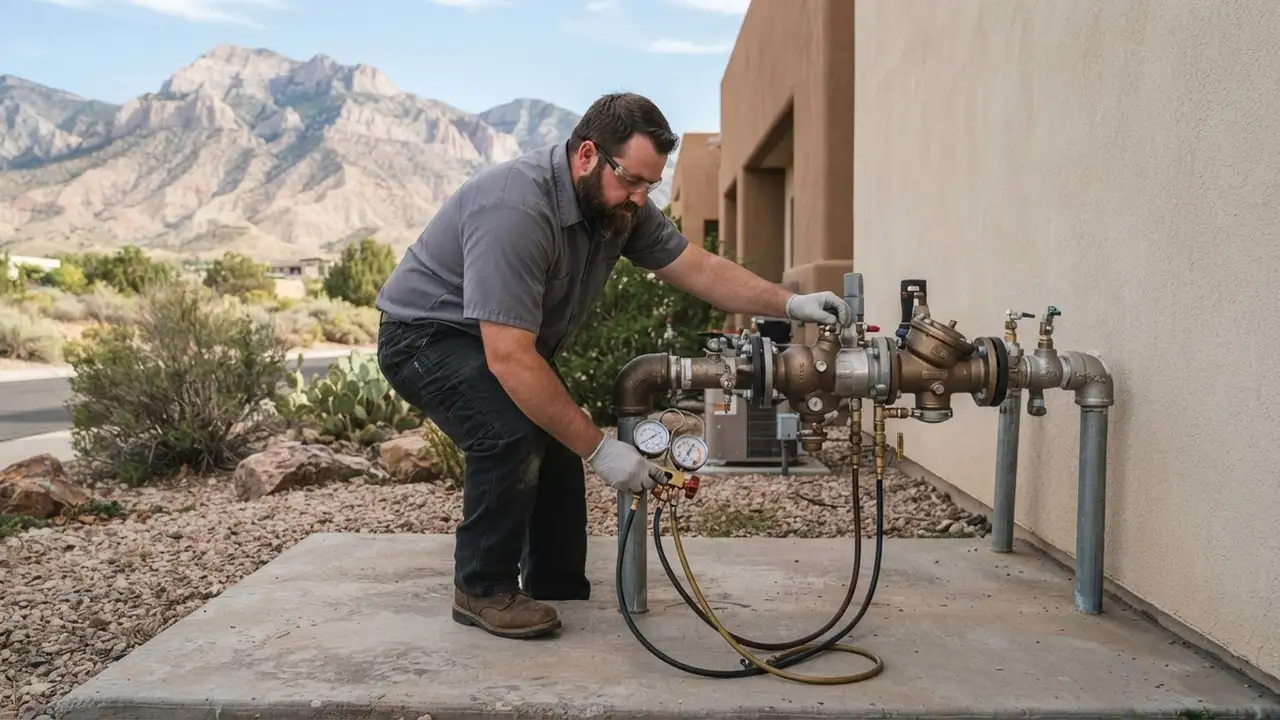
If your water service crosses a potential contamination source, you need a reduced pressure principle assembly (RPZ) when the hazard is high and a double check valve assembly (DCVA) when the hazard is low. That single rule answers most RPZ vs double check valve questions in Utah. The rest of this article walks through how Utah code, your specific application, and your water purveyor's requirements narrow that choice down to the exact assembly you should install and test.
We test thousands of assemblies across the Wasatch Front and southern Utah every year, and the same three questions come up on nearly every job: is this a health hazard or a non-health hazard, what does my city require, and what will it cost to keep it certified. Here is how we answer each one.
The short answer: RPZ vs double check valve
An RPZ is required for high-hazard connections where backflow could cause illness or death; a DCVA is allowed only for low-hazard connections where backflow would be a nuisance but not a health risk. The RPZ has a relief valve that dumps water to the ground if either check fails, which is why it protects against both backflow and backsiphonage. A DCVA has two check valves and no relief port, so it protects against backflow only and cannot be used where a health hazard exists.
RPZ vs double check valve which backflow assembly do I need is really a hazard-classification question. Once you know the hazard class, the assembly type is almost always predetermined by Utah Plumbing Code and your local water purveyor.
If you want the full picture of how we test and certify both assembly types, our team handles Backflow Prevention Assembly Testing in Utah for residential, commercial, and fire-line accounts across the state.
What is the difference between an RPZ and a double check valve in Utah?
In Utah, the difference between an RPZ and a double check valve comes down to three things: the number of check valves, the presence of a relief valve, and the hazard level each is approved to protect against. An RPZ has two independently acting check valves plus a differential relief valve located between them. A DCVA has two check valves and no relief valve.
Here is how they compare on the specs that matter in the field:
- RPZ: two check valves + relief valve, protects against backpressure and backsiphonage, approved for high-hazard (health hazard) connections, requires a 4-inch minimum air gap or drain for relief discharge.
- DCVA: two check valves, protects against backpressure only, approved for low-hazard (non-health hazard) connections, no relief discharge, no drain required.
- Test frequency: both must be tested annually in Utah, and most purveyors require the test by a certified tester.
- Typical 2026 install cost: $450-$900 for a residential DCVA, $650-$1,400 for a residential RPZ, plus permit fees that run $30-$120 depending on the city.
RPZ assemblies are also physically larger and heavier than DCVAs at the same line size, which matters when you are trying to fit one into a tight mechanical room or a shallow irrigation vault. If space is tight, that alone can push a design toward a DCVA - but only when the hazard class allows it.
When to use an RPZ vs DCVA in Utah
Use an RPZ in Utah whenever the downstream water could harm human health if it flowed backward into the potable supply. Use a DCVA only when the downstream water is a non-health hazard - meaning it would be unpleasant or objectionable but not dangerous.
Real-world examples we see on Utah jobs:
- RPZ required: commercial kitchens, car washes, dental offices, medical clinics, chemical injection systems, boiler feed lines, cooling towers, and any connection where a chemical, biological, or radiological contaminant could enter the line.
- DCVA allowed: many fire sprinkler lines (when no antifreeze or chemical additive is present), dedicated irrigation lines on a separate meter in some cities, and certain commercial process water lines where the downstream water is potable-quality.
Your water purveyor has the final say. Salt Lake City, Sandy, Provo, and Ogden each publish their own approved-assembly lists, and a few Utah cities are stricter than the state minimum. We see this most often in Backflow Testing in Salt Lake City, where older downtown buildings and dense commercial blocks mean more high-hazard connections per block than almost anywhere else in the state.
Which backflow assembly does Utah require for irrigation?
Utah requires a reduced pressure principle assembly (RPZ) or a pressure vacuum breaker (PVB) for most irrigation systems, depending on whether the system has below-grade sprinkler heads and whether the connection is a health hazard. A DCVA is not approved for irrigation in most Utah cities because fertilizer, pesticides, and animal waste make irrigation water a health hazard.
Here is the practical breakdown:
- PVB: allowed only when all sprinkler heads are at least 6 inches above the highest downstream point and there is no possibility of backpressure. Common on simple residential systems in Utah County.
- RPZ: required when the system has below-grade heads, a booster pump, or any chemical injection. This is the default for most commercial and HOA irrigation in Utah.
- DCVA: rarely approved for irrigation in Utah - do not assume it will pass inspection.
We handle both assembly types on irrigation accounts through our Irrigation System Backflow Testing in Utah service, and we can tell you in one phone call which one your city will accept.
Which backflow assembly does Utah require for fire sprinklers?
Utah requires a double check valve assembly (DCVA) or a double check detector assembly (DCDA) for most fire sprinkler systems, and an RPZ only when the system contains antifreeze, foam concentrate, or another chemical additive. A standard wet-pipe fire line with no additives is a low hazard, so a DCVA is the correct and code-approved choice.
Key details we check on every fire-line job:
- DCDA vs DCVA: systems with a fire department connection (FDC) usually require a detector assembly so unmetered water use is captured.
- Antifreeze loops: if the system has an antifreeze loop, the assembly must be an RPZ - no exceptions.
- Annual test: Utah fire sprinkler backflow assemblies must be tested every 12 months, and many cities also require a 5-year forward-flow test on the DCVA.
Our Fire Sprinkler System Backflow Testing in Utah team handles both the annual certification and the 5-year forward-flow test, and we file the paperwork with your purveyor so you do not have to.
Utah backflow assembly requirements by application
Utah backflow assembly requirements by application follow the hazard class of the connection, not the size of the building. A small dental office needs an RPZ; a large warehouse with a simple fire line may only need a DCVA.
Here is the quick-reference table we use in the field:
- Residential irrigation (above-grade heads): PVB
- Residential irrigation (below-grade heads or pump): RPZ
- Residential fire sprinkler (wet pipe, no antifreeze): DCVA or DCDA
- Commercial fire sprinkler (wet pipe, no antifreeze): DCVA or DCDA
- Commercial fire sprinkler (antifreeze loop): RPZ
- Commercial kitchen, car wash, dental, medical: RPZ
- Boiler feed, cooling tower, chemical injection: RPZ
- Dedicated irrigation meter (some cities): DCVA or RPZ - check with the purveyor
If you are not sure which row your property falls into, our Commercial Backflow Testing in Utah team can classify the hazard and tell you exactly which assembly your city will approve before you buy anything.
Common mistakes we see on Utah backflow assemblies
The most common mistake we see is a homeowner or contractor installing a DCVA where an RPZ is required, usually on an irrigation system with below-grade heads. It passes the first inspection in some cities and then fails the annual test - or worse, gets flagged by the purveyor during a cross-connection survey.
Other mistakes that cost real money:
- Sizing the assembly to the pipe, not the flow. An oversized RPZ will chatter and fail test. Size to the actual demand, not the line diameter.
- No drain for the RPZ relief port. Utah code requires the relief discharge to drain to a safe location. We see RPZs piped to a bucket or a floor drain that backs up.
- Skipping the annual test. Most Utah cities will shut off water service after 30-60 days past the test due date. The fine is usually $50-$200 on top of the test fee.
- Using a non-certified tester. Utah requires the tester to hold current certification, and the purveyor will reject the report if the certification number is expired.
- Freezing. RPZs and DCVAs installed above ground in northern Utah need insulation and heat trace. We replace more freeze-damaged RPZ relief valves in January than any other month.
If you are in an area with a lot of new construction and rapid irrigation installs, this is worth a second look - we see the highest rate of misapplied assemblies in Backflow Testing in Lehi, where new subdivisions and HOA irrigation systems have gone in fast over the last few years.
When to call a professional
Call a professional when you are installing a new assembly, when your annual test is due, when your purveyor has flagged your property, or when you are not sure whether your connection is a high hazard or a low hazard. Getting the hazard class wrong is the single most expensive mistake in this trade - it usually means buying the wrong assembly, failing inspection, and paying for a second install.
Our team at Utah Backflow Specialists classifies the hazard, pulls the permit, installs the correct assembly, and files the certification with your city. We carry the test kits, the gauges, and the certification to test every assembly type approved in Utah. If you are not sure what you have, we can identify it from a photo in most cases.
Frequently Asked Questions
What is the difference between an RPZ and a double check valve in Utah?
An RPZ has two check valves plus a relief valve and is approved for high-hazard connections. A DCVA has two check valves and no relief valve and is approved only for low-hazard connections. Utah code and your water purveyor decide which one your property requires.
Which backflow assembly does Utah require for irrigation?
Most Utah irrigation systems require an RPZ or a PVB. A PVB is allowed only when all heads are 6 inches above the highest downstream point and there is no backpressure risk. Below-grade heads, booster pumps, or chemical injection require an RPZ.
Which backflow assembly does Utah require for fire sprinklers?
Most Utah fire sprinkler systems require a DCVA or DCDA. An RPZ is required only when the system contains antifreeze, foam, or another chemical additive. Annual testing is required every 12 months, plus a 5-year forward-flow test on many DCVAs.
How do I know which backflow assembly I need in Utah?
Classify the hazard first: high hazard needs an RPZ, low hazard allows a DCVA. Then check your city's approved-assembly list, because a few Utah purveyors are stricter than the state minimum. When in doubt, call a certified tester before you buy.
How much does an RPZ or DCVA cost in Utah in 2026?
Typical 2026 installed pricing in Utah runs $450-$900 for a residential DCVA and $650-$1,400 for a residential RPZ, plus $30-$120 in permit fees. Annual testing runs $75-$150 for a residential assembly and $125-$300 for commercial or fire-line assemblies.
Get help with Backflow Testing in Utah
If you are still not sure whether your property needs an RPZ or a double check valve, we can tell you in one call. We test, certify, and install every assembly type approved in Utah, and we file the paperwork with your city so you stay in compliance.
Call Utah Backflow Specialists at 555 123456 to schedule your test or to get a straight answer on which assembly your property requires.