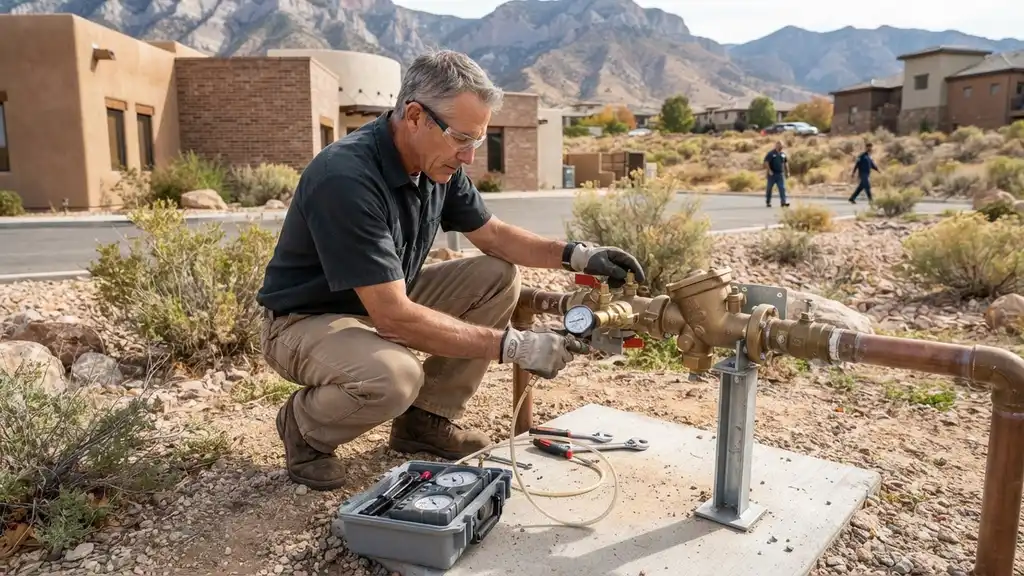
Spring startup backflow testing for Utah irrigation systems is the annual certification your sprinkler system needs before you turn the water on for the season. In most Utah cities, you must test your irrigation backflow assembly every spring and file the results with your water district. Skipping it can mean a fine, a shut-off notice, or contaminated water flowing back into your home's drinking supply.
We run these tests every March through May across the Wasatch Front, and the same handful of problems show up year after year. Below we cover when to schedule, what the test involves, what it costs in 2026, and the failures we see most often.
Why Spring Startup Backflow Testing for Utah Irrigation Systems Matters
Spring startup backflow testing for Utah irrigation systems matters because your sprinkler lines sit stagnant and pressurized all winter, and that is exactly when rubber seals crack and springs lose tension. A backflow assembly is a mechanical valve that stops irrigation water from reversing into your drinking water lines. When it fails, fertilizer, dog waste, and standing water from your lawn can siphon backward into the same pipes that feed your kitchen sink.
Utah code requires annual testing on most irrigation assemblies, and your local water district tracks the certification. If your test is overdue, the district can terminate your irrigation service until you pass. We have seen homeowners in Backflow Testing in Sandy get shut-off notices in late April simply because they forgot the deadline.
The test itself takes 15 to 30 minutes for a standard residential irrigation assembly. It is not a repair visit. It is a certification that proves the valve still does its one job.
When Should You Schedule Irrigation Backflow Testing in Utah?
Schedule irrigation backflow testing in Utah for late March through mid-May, before you pressurize your sprinkler system for the season. Most Wasatch Front cities require certification by May 1 or June 1, so booking in March gives you time to fix a failed assembly without missing the deadline.
Here is the timing we recommend:
- Late March to early April: Book your test. This is before the rush, and techs have open slots.
- Mid-April: Turn on the irrigation water and run each zone for two minutes to check for cracked heads and leaks.
- Late April to mid-May: Peak demand. Wait times stretch to one to two weeks.
- June 1: Common certification deadline across Salt Lake, Davis, Utah, and Weber county water districts.
If you are in a colder pocket like Backflow Testing in Logan, wait until the ground thaws and overnight temps stay above freezing. Testing a frozen assembly can damage the internal seals and give you a false failure.
What Happens During a Spring Sprinkler Backflow Test
A spring sprinkler backflow test checks whether your assembly still prevents reverse flow under real pressure. The technician shuts off the irrigation supply, attaches a test kit to the assembly's test cocks, and runs a sequence of pressure checks that match the assembly type.
Most Utah homes have one of three assemblies:
- Pressure Vacuum Breaker (PVB): Common on older residential irrigation. Tested for air inlet opening and check valve hold.
- Reduced Pressure Principle Assembly (RPZ): Required in many commercial and high-hazard applications. Tested for differential pressure across two check valves and a relief valve.
- Double Check Valve Assembly (DCVA): Used where backpressure is the main risk. Tested for tightness on both check valves.
If your system uses a PVB, we handle Utah PVB testing on site and submit the certification to your water district the same day. For commercial properties with an RPZ, we run the full differential test and document each reading.
After the test, you get a copy of the certification. Your water district gets the original. Keep your copy - some cities ask for it when you sell the home.
Common Spring Irrigation Backflow Failures in Utah
Common spring irrigation backflow failures in Utah come down to freeze damage, worn rubber, and debris. Our techs see the same five problems on roughly a third of the assemblies we test each spring.
- Cracked check valve seals. Water left in the assembly freezes, expands, and splits the rubber disc. The valve leaks by and fails the hold test.
- Weak relief valve spring on an RPZ. The spring loses tension over winter, and the relief valve opens below the required 2 psi differential.
- Debris in the test cocks. Utah's hard water leaves mineral scale that clogs the small ports. The test kit cannot get a clean reading.
- Broken bonnet or cracked body. A hard freeze splits the brass housing. This one is not repairable - the assembly has to be replaced.
- Missing or unreadable tag. Water districts require a visible tag with the assembly's make, model, size, and serial number. Faded tags fail inspection.
If your assembly is a DCVA, we test it under Utah DCVA testing protocols and can usually replace a failed check valve the same visit. RPZ repairs are more involved because the relief valve has to be re-set to spec.
How Much Does Spring Irrigation Backflow Testing Cost in Utah?
Spring irrigation backflow testing in Utah runs $75 to $150 for a standard residential assembly in 2026, with most homeowners paying around $95 to $120. Commercial RPZ testing typically runs $150 to $300 depending on assembly size and location.
What drives the price:
- Assembly type: PVB and DCVA tests are quicker. RPZ tests take longer and cost more.
- Assembly size: A 3/4-inch residential unit is the base price. A 2-inch commercial unit is roughly double.
- Travel: Rural addresses outside the Wasatch Front add a trip charge.
- Repairs: A failed test means parts and labor on top of the test fee. A new check valve kit runs $40 to $90 installed. A full assembly replacement runs $250 to $600 depending on size.
Many water districts send reminder cards in February with a list of certified testers. You are not required to use the tester on that list, but the tester does have to be certified by the state. We handle Utah irrigation backflow testing for homeowners and property managers across the state and file the paperwork for you.
What to Watch Out For
Watch out for three things during spring startup: skipping the test because the system "worked fine last year," turning the water on before the test, and hiring an uncertified tester who cannot file with your district.
Backflow assemblies fail silently. A valve that passed last May can fail over a single hard freeze in January. You will not see a leak or a drop in sprinkler pressure - the failure only shows up on a test gauge.
Also watch the timing. If you turn the irrigation water on before the test, you pressurize a possibly-failed assembly and risk pushing contaminated water into your home lines. Test first, then pressurize.
Finally, verify the tester's certification. Utah requires backflow assembly testers to hold a current state certification, and each water district maintains its own approved list. An uncertified tester can run the gauge, but the district will reject the form.
When to Call a Professional
Call a professional when your test is due, when you find a cracked or leaking assembly, or when your water district sends a compliance notice. Backflow testing requires a calibrated gauge and a state certification - it is not a DIY job.
Our team at Utah Backflow Specialists handles Backflow Testing in Utah for residential and commercial irrigation systems. We test, repair, and file the certification with your water district in one visit. If your assembly fails, we carry common replacement parts on the truck so most repairs are same-day.
We also test fire sprinkler lines, commercial RPZ assemblies, and residential systems on city water. If you manage multiple properties, we can schedule all of them in a single route to keep your certifications current.
Frequently Asked Questions
When should I schedule irrigation backflow testing in Utah?
Schedule for late March through mid-May, before you turn the irrigation water on. Most Utah water districts require certification by May 1 or June 1. Booking in March avoids the April rush and gives you time to repair a failed assembly before the deadline.
Why is spring the best time for irrigation backflow testing in Utah?
Spring is when freeze damage from winter shows up. Testing before you pressurize the system catches cracked seals and split bodies early. It also lines up with the annual certification cycle most Utah cities enforce, so you stay compliant without a second visit.
How much does spring irrigation backflow testing cost in Utah?
Expect $75 to $150 for a standard residential assembly in 2026, with most homeowners paying $95 to $120. Commercial RPZ testing runs $150 to $300. Repairs are extra - a check valve kit is $40 to $90 installed, and a full assembly replacement is $250 to $600.
What happens if I skip spring irrigation backflow testing in Utah?
Your water district can fine you and shut off your irrigation service until you pass. You also risk contaminated water siphoning into your home's drinking supply. Most districts send one reminder, then issue a compliance notice with a 10 to 30 day cure period.
How long does a spring backflow test take?
A standard residential irrigation test takes 15 to 30 minutes on site. RPZ assemblies take 30 to 45 minutes because of the extra differential checks. If the assembly fails and needs a repair, add 30 to 60 minutes for the fix and a re-test.
Get Help with Backflow Testing in Utah
Spring startup backflow testing for Utah irrigation systems is a 20-minute job that keeps your water safe and your sprinklers legal. We test, repair, and file - all in one visit.
Call Utah Backflow Specialists at 555 123456 to schedule your spring test before the May deadline.