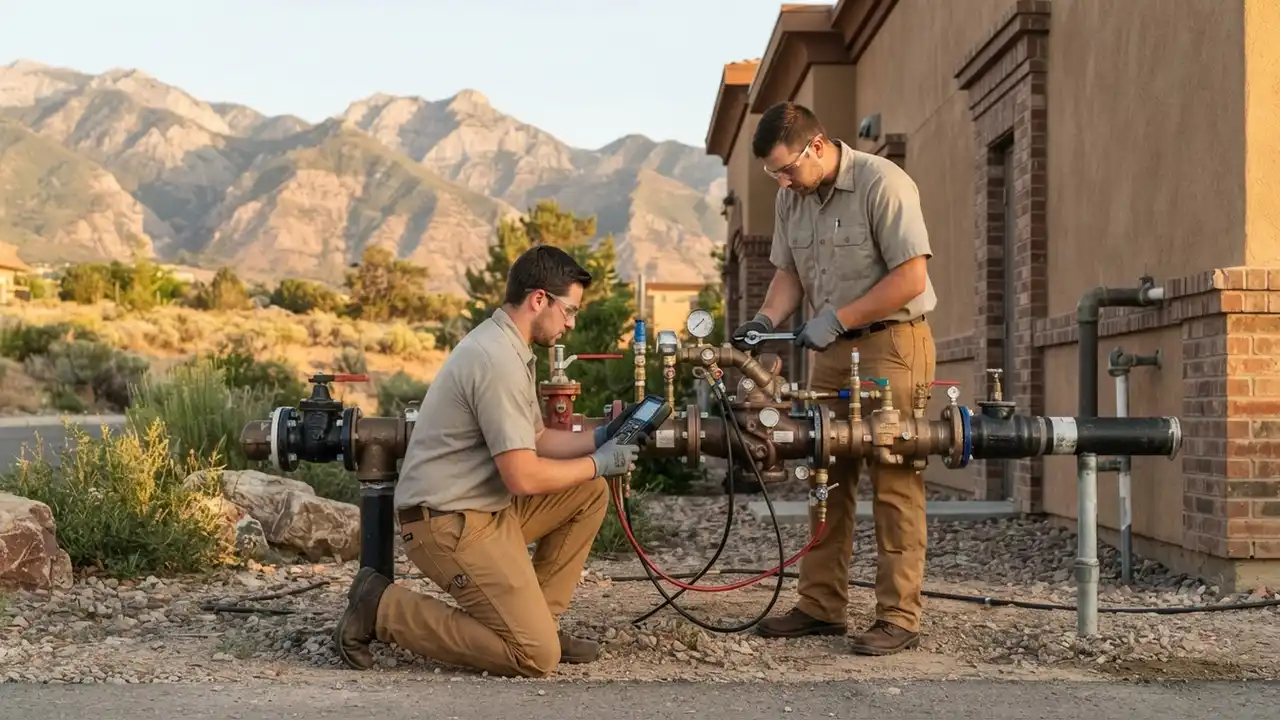
If you skip backflow testing in Utah, your water supplier can send a compliance letter, fine you, and ultimately shut off your water until a certified test is filed. The first consequence is usually a notice, not a shutoff - but the clock starts ticking the day that letter arrives.
This post breaks down exactly what happens after a missed test, how Utah enforcement works, what fines look like in 2026, and how to get back into compliance without dragging it out. We'll also cover the mistakes that turn a simple late test into a real problem.
The immediate consequences of skipping backflow testing in Utah
What happens if you skip backflow testing in Utah is a compliance process that starts quietly and escalates fast. Your water district or municipality tracks every backflow assembly in its service area and flags the ones without a current test report on file.
Most Utah water systems require annual testing for reduced pressure principle assemblies, double check valve assemblies, and pressure vacuum breakers. The test report has to be submitted by a certified backflow assembly tester - not by the property owner.
When that report doesn't show up, here's the typical sequence:
- Reminder notice - sent 30 to 60 days before your test due date. Easy to ignore, easy to fix.
- Compliance letter - sent after the due date passes. This one usually includes a deadline and a warning about penalties.
- Second notice with a fine - if you still don't respond, the water district can assess a penalty and set a hard cutoff date.
- Water shutoff - the final step. Your service gets terminated until a passing test is filed.
We've seen homeowners in Backflow Testing in Sandy get a compliance letter in the mail and assume it's junk. It isn't. That letter is the district's official record that you're out of compliance, and it starts the enforcement clock.
The good news: almost every violation we deal with gets resolved with one phone call and one test. The bad news: ignoring it never makes it go away.
How Utah backflow testing enforcement actually works
Utah backflow testing enforcement is run by individual water suppliers, not by a single state agency. That means the rules, deadlines, and penalties can differ depending on whether you're in Salt Lake City, Provo, Ogden, or a smaller district.
The state sets the framework through the Utah Division of Drinking Water, which requires public water systems to maintain a cross-connection control program. Each water system then enforces that program locally.
In practice, that means:
- Your water district keeps a database of every backflow assembly in its service area.
- Certified testers submit test reports directly to the district after each test.
- Properties without a current report get flagged automatically.
- Enforcement letters go out on the district's schedule, not yours.
Some districts send notices in the spring, others in the fall. Some give you 30 days to comply, others give you 10. We've worked in districts where the first letter is a gentle reminder, and we've worked in districts where the first letter already includes a fine amount.
If you're not sure who your water supplier is, check your bill. That's the agency that will shut off your water if the test doesn't get done.
Fines and penalties for missing backflow testing in Utah
Utah backflow testing penalties typically range from $50 to $500 per missed test, depending on the water district. Some districts charge a flat fee; others add daily penalties until the test is filed.
Here's what we see across the Wasatch Front and other Utah service areas in 2026:
- First late notice: usually $0 - just a warning and a deadline.
- Second notice: $50 to $150 fine, plus the cost of the test once you schedule it.
- Third notice: $150 to $500, sometimes with a shutoff warning.
- After shutoff: fine plus a reconnection fee, which can run $100 to $300 on top of the test.
The fine is rarely the biggest cost. The bigger cost is the shutoff, the reconnection fee, and the time you spend chasing paperwork to get water back on.
Commercial properties face steeper penalties. A restaurant or apartment building without a current test can be fined per assembly, per day, in some districts. If you manage commercial property, Commercial Backflow Testing in Utah is worth scheduling before the district sends anything.
Homeowners aren't exempt. If you have an irrigation system, a boiler, a fire sprinkler line, or a pool fill line, you likely have a backflow assembly that needs annual testing. Residential Backflow Testing in Utah covers the assemblies most homes have, and it's usually a 20-minute visit.
Can water be shut off for no backflow testing in Utah?
Yes - water can be shut off for no backflow testing in Utah. It's the final enforcement step, and districts use it when a property ignores multiple notices.
The shutoff doesn't happen overnight. Most districts send at least two notices and give you a written deadline before terminating service. But once that deadline passes, the district can and does shut off water.
What that looks like in practice:
- You get a shutoff notice with a specific date.
- On that date, the district physically disables your service line.
- You can't get water back on until a certified tester files a passing test report.
- You also pay a reconnection fee, which varies by district.
For a homeowner, that means no showers, no laundry, no dishwasher, no irrigation. For a business, it means closing until water is restored. We've been called out to restaurants that got shut off on a Friday and needed a test filed the same day to reopen for the weekend.
The fix is simple: get the test done before the deadline. If you've already missed it, call a certified tester and explain the situation. Most districts will work with you if a test is scheduled.
What to watch out for: common mistakes that trigger violations
The most common mistake we see is assuming the test was done because someone else was supposed to handle it. Property managers, HOAs, and landlords often think the tenant scheduled it. The tenant thinks the landlord did. Nobody did.
Other mistakes that lead to violations:
- Letting the test report expire. A test is good for 12 months in most Utah districts. The day it expires, you're out of compliance.
- Using an uncertified tester. If the tester isn't certified in Utah, the district won't accept the report. You'll pay twice.
- Ignoring the assembly type. RPZ assemblies, DCVAs, PVBs, SVBs, and AVBs all have different testing requirements. Some need annual testing; some need it more often.
- Missing the irrigation assembly. Irrigation backflow assemblies are the most commonly forgotten. They're buried, out of sight, and easy to overlook until the district flags them.
- Not updating your contact info with the district. If notices go to an old address, you never see them - until the shutoff notice shows up.
We also see properties where the assembly was removed or replaced without notifying the district. That creates a records mismatch that can trigger a violation even if you're technically in compliance.
If you're not sure what assemblies you have or when they were last tested, that's the first thing to sort out. Backflow Prevention Assembly Testing in Utah covers every assembly type, and we can tell you exactly what's on your property and what's due.
How to get back into compliance after missing backflow testing in Utah
Getting back into compliance after missing backflow testing in Utah is usually a one-visit fix. Here's the process:
- Call a certified tester. Tell them you have a compliance letter or shutoff notice. They'll prioritize the visit.
- Schedule the test. Most tests take 20 to 30 minutes per assembly. If you have multiple assemblies, budget an hour.
- Fix any failures. If the assembly fails, it needs repair or replacement before it can pass. A repair usually runs $150 to $400; a replacement runs $300 to $800 depending on size and type.
- File the report. The tester submits the passing report directly to your water district. You don't have to do anything.
- Confirm with the district. If you were already shut off, call the district to confirm the report was received and schedule reconnection.
The whole process can be done in a day if you catch it early. If you wait until the shutoff date, you're looking at a day or two without water plus reconnection fees.
If you're in the middle of this right now, don't panic. We handle compliance cases every week. Backflow Testing in Utah is what we do, and we know how each district operates.
When to call a professional
Call a professional the moment you get a compliance letter, a shutoff notice, or a reminder that your test is due. The earlier you call, the cheaper and faster the fix.
You should also call if:
- You don't know what backflow assemblies you have or where they are.
- Your assembly failed a previous test and you haven't repaired it.
- You're buying or selling a property and need a current test for closing.
- You manage a commercial property with multiple assemblies.
- You've received a notice but the deadline is less than two weeks away.
Our team at Utah Backflow Specialists handles residential and commercial backflow testing across Utah. We test every assembly type, file reports directly with your water district, and tell you upfront what the test will cost before we schedule.
If your assembly fails, we'll explain what needs to be repaired or replaced and give you a clear price. No surprises.
Frequently Asked Questions
What happens if you skip backflow testing in Utah?
You'll receive a compliance letter from your water district, followed by fines of $50 to $500 and eventually a water shutoff if you don't comply. The district tracks every assembly and flags missing test reports automatically.
Does Utah fine homeowners for missing backflow testing?
Yes. Homeowners with backflow assemblies - typically irrigation systems, boilers, or fire sprinkler lines - can be fined $50 to $500 for missing a test. The fine amount depends on your water district and how many notices you've ignored.
Can my water service be shut off for skipping backflow testing in Utah?
Yes. Water districts can shut off service after multiple notices and a missed deadline. You'll also pay a reconnection fee, usually $100 to $300, on top of the test and any fines.
How do I fix a backflow testing violation in Utah?
Call a certified backflow tester, schedule the test, and let them file the report with your district. If the assembly fails, repair or replace it, then retest. Most violations are resolved within one to two days.
How often does backflow testing need to be done in Utah?
Most Utah water districts require annual testing for RPZ, DCVA, and PVB assemblies. Some districts require testing every two years for certain assembly types, but annual is the standard across the Wasatch Front.
Get help with Backflow Testing in Utah
If you've missed a test, received a compliance letter, or just want to confirm you're current, we can help. We test every assembly type, file reports directly with your water district, and get you back into compliance fast.
Call Utah Backflow Specialists at 555 123456 to schedule your test or ask about a violation you're dealing with.