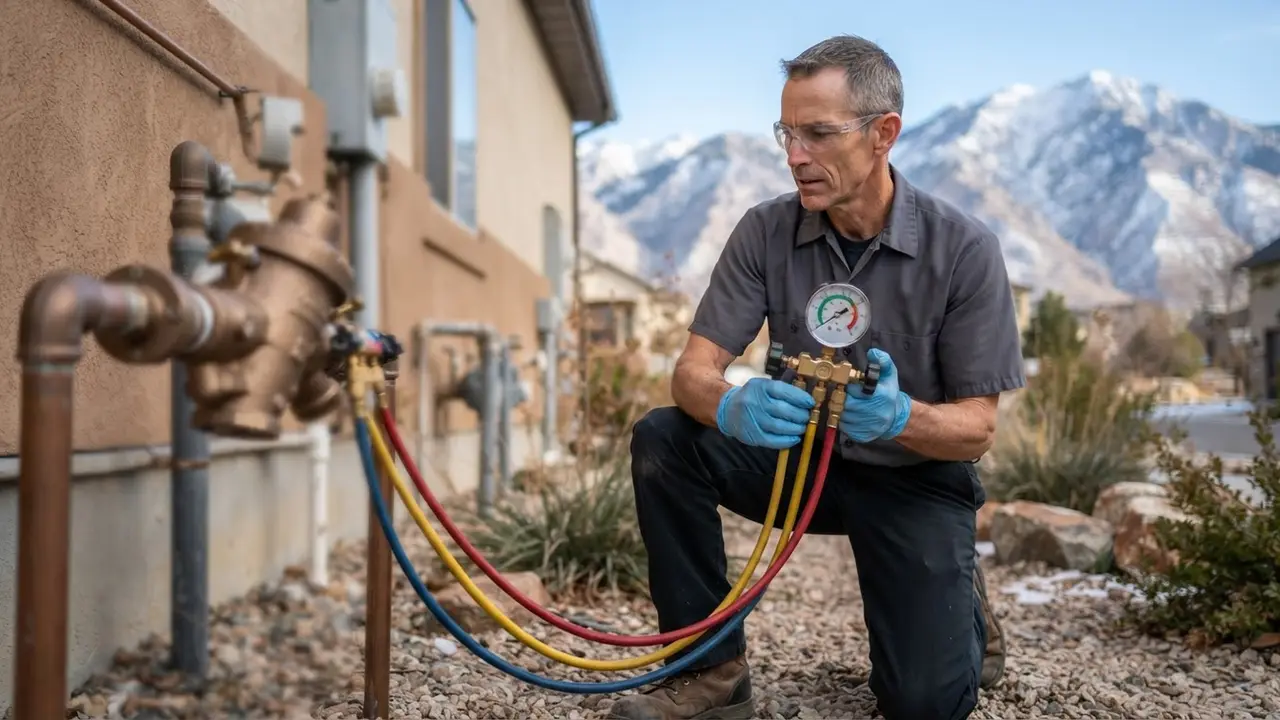
In Utah, the landlord almost always pays for backflow testing on a rental property - unless the lease explicitly shifts that cost to the tenant. That single sentence answers the question, but the real-world details matter because Utah code, local water district rules, and the type of backflow assembly on the property all influence who actually writes the check. If you are a tenant staring at a notice from the city, or a landlord trying to figure out why your property manager is asking for $150, this guide walks through the lease language, the legal backdrop, and the practical steps for both sides. We handle these calls every week across the Wasatch Front, and the confusion is almost always the same.
The Short Answer: It Depends on Your Lease and the Assembly Type
Who pays for backflow testing landlord or tenant in Utah is a question that gets settled in one of two places: the lease agreement or the local water district's cross-connection control ordinance. In most Utah residential leases, the landlord covers backflow testing as part of routine property maintenance - similar to how they cover furnace inspections or water heater repairs. The tenant's role is to provide access to the assembly, not to pay for the test itself.
That flips in some commercial leases, especially triple-net (NNN) agreements where the tenant is responsible for all maintenance, taxes, and insurance. In those cases, the tenant pays for backflow testing directly. We also see residential leases where a landlord has added a clause stating the tenant is responsible for "any required testing of water safety devices" - that language is vague, but it has been used to pass the cost to tenants in small claims disputes.
Backflow testing is a plumbing maintenance service that verifies a backflow prevention assembly is stopping contaminated water from reversing into the clean water supply. It is required annually in most Utah municipalities, and the test must be performed by a state-certified backflow assembly tester. The assembly type matters too: a simple PVB backflow testing Utah on a residential irrigation line costs less than testing a reduced pressure principle assembly on a commercial fire line, and that cost difference often determines who ends up paying.
Utah Law and Local Code: What Actually Governs Responsibility
Utah does not have a single statewide statute that says "landlords pay for backflow testing." Instead, responsibility is governed by local water district ordinances and the Utah Administrative Code's plumbing provisions. The Utah Division of Drinking Water requires public water systems to maintain a cross-connection control program, and most cities - Salt Lake City, Provo, Ogden, Sandy, and others - adopt their own ordinances that mandate annual testing for certain assemblies.
Those ordinances typically place the testing obligation on the property owner, not the occupant. The water district sends the annual test notice to the address on the water account, which is usually the landlord or property management company. If the test is not completed, the water district can shut off service or issue fines - and those penalties land on the account holder, not the tenant.
That is why most Utah property managers treat backflow testing as a landlord expense. It is tied to the water account, it is a condition of keeping water service active, and it protects the landlord's asset. A tenant who refuses access can be in breach of lease, but a tenant who pays for the test without a lease clause requiring it is usually doing the landlord a favor they are not obligated to do.
If you are in an older building - say a 1970s fourplex in Millcreek backflow prevention Millcreek Utah - the assembly may be original and the ordinance may have changed since it was installed. We see this constantly: a landlord inherits a property, the water district starts enforcing a newer cross-connection rule, and suddenly there is a $200 test and possibly a $400 repair on an assembly nobody knew existed.
How to Read Your Utah Lease for Backflow Testing Clauses
Utah lease clauses for backflow testing are not standardized. Some leases mention "backflow" by name; most do not. Here is what to look for in your rental agreement:
- Maintenance and repairs clause: If it says the landlord is responsible for maintaining plumbing systems and appliances, backflow testing likely falls under that umbrella.
- Utilities clause: If the tenant pays the water bill, some landlords argue the tenant should pay for testing. That argument is weak - the test is a property maintenance item, not a utility usage charge.
- Compliance with laws clause: This often says the tenant must comply with all applicable laws. It does not say the tenant must pay for compliance. Landlords sometimes try to stretch this language.
- Explicit backflow clause: Rare but growing. If your lease specifically names backflow testing and assigns it to the tenant, that is enforceable in most Utah courts.
If your lease is silent on backflow testing - which is the case for most Utah rentals - the default is that the landlord pays. The tenant's obligation is to allow access for the test. We tell tenants to ask for the test notice in writing and to confirm the appointment time at least 48 hours in advance so they can arrange to be home or leave a key.
For landlords, the smart move is to add a clear backflow testing clause to every lease. It does not have to shift the cost to the tenant. It just needs to state that the landlord will schedule annual testing and the tenant will provide access. That one paragraph prevents 90% of the disputes we hear about.
Residential vs. Commercial Rentals: Different Rules, Different Costs
Residential rental property backflow testing in Utah usually involves one of three assembly types: a double check valve assembly (DCVA) on the main domestic line, a pressure vacuum breaker (PVB) on irrigation, or a reduced pressure principle assembly (RPZ) if there is a boiler or fire suppression system. Typical 2026 pricing for a residential test runs $75 to $150 per assembly, with the lower end for a simple PVB and the higher end for an RPZ that requires a more involved procedure.
Commercial tenant backflow testing Utah is a different animal. A restaurant with a fire sprinkler system, a boiler, and multiple hose bibs might have four or five assemblies. Testing all of them can run $400 to $900 depending on assembly types and access. In a triple-net lease, that cost lands on the tenant. In a gross lease, the landlord pays and bakes it into the rent.
We handle both sides. For residential landlords, we schedule the test, send the certification to the water district, and email a copy to the property manager. For commercial tenants, we coordinate with the building engineer and provide the documentation the health department or fire marshal needs. If you are a business owner dealing with a business backflow testing Utah requirement, the key is to get the test done before the water district's deadline - not after the shutoff notice arrives.
Who Schedules the Test and What Happens If Nobody Does
In most Utah rentals, the landlord or property manager schedules the test. The water district mails the notice to the account holder, and the account holder is responsible for hiring a certified tester and submitting the results. The tenant's job is to provide access to the assembly, which is usually in a mechanical room, a crawlspace, or an exterior vault.
If nobody schedules the test, the water district will eventually shut off water service. That is not a bluff. We have seen it happen in West Jordan backflow testing company West Jordan when a landlord ignored three notices and the tenant called us in a panic because the water was off. The reinstatement fee plus the test plus the missed notices added up to more than $500.
If you are a tenant and your landlord is not responding to the water district notice, put your request in writing. Utah law gives tenants the right to reasonable habitability, and water service is part of that. If the landlord still does not act, you can pay for the test yourself and deduct it from rent - but only if you follow the proper notice procedure. Talk to a tenant rights attorney before you withhold rent.
If you are a landlord and your tenant refuses access, document every attempt. Send a written notice, offer two or three appointment windows, and keep a log. If the tenant still refuses, that is a lease violation and grounds for eviction in most Utah courts. We have worked with property managers who had to go that route, and the documentation made the difference.
Common Mistakes Landlords and Tenants Make
The biggest mistake is assuming the other party is handling it. We see this every spring when water districts send out annual notices. The landlord thinks the tenant will call a tester. The tenant thinks the landlord already did. Nobody calls, and the deadline passes.
Other mistakes we see regularly:
- Using an uncertified tester. Utah requires backflow testers to hold a current certification. A handyman with a gauge is not enough, and the water district will reject the paperwork.
- Testing the wrong assembly. A property might have both an irrigation PVB and a domestic DCVA. Testing one does not satisfy the requirement for the other.
- Ignoring the repair. If the assembly fails the test, it has to be repaired or replaced and retested. Some landlords try to submit the failed test and hope the water district does not notice. They notice.
- Not keeping records. Water districts can audit. If you cannot produce the test certification from the last three years, you may be required to test immediately.
We also see leases that try to pass all plumbing maintenance to the tenant without a clear explanation. That is legal in Utah if the tenant agrees, but it creates friction. A tenant who did not read the fine print is not going to be happy when they get a $150 bill for a test they did not know was required.
When to Call a Professional
Call a certified backflow tester when you get the annual notice from your water district, when you are buying or selling a property with a backflow assembly, or when you are a landlord who wants to set up a recurring testing schedule so you never miss a deadline. We handle the paperwork, the test, and the submission to the water district. You get a copy of the certification for your records.
If you are a tenant and your landlord is not responding, call us and we can tell you what the local ordinance requires. We cannot force your landlord to pay, but we can tell you whether the assembly on your property is actually due for testing and what the typical cost is. That information helps you make your case in writing.
If you are a landlord with multiple properties, we can set up a schedule that covers all of them. We send reminders 30 days before each test is due, coordinate access with tenants, and keep the certifications on file. That is the easiest way to stay compliant without tracking deadlines yourself.
Frequently Asked Questions
Who pays for backflow testing landlord or tenant in Utah?
The landlord pays in most Utah residential rentals unless the lease specifically assigns the cost to the tenant. For commercial rentals, especially triple-net leases, the tenant usually pays. The water district sends the notice to the account holder, which is typically the landlord or property manager.
Is backflow testing the landlord's responsibility in Utah?
Yes, in most cases. Utah water districts place the testing obligation on the property owner, and the annual notice goes to the water account holder. The tenant's responsibility is to provide access to the assembly, not to pay for the test.
Can a Utah landlord pass backflow testing costs to tenants?
Yes, if the lease includes a clear clause assigning that cost to the tenant. Without that clause, the landlord is responsible. We recommend landlords add a specific backflow testing clause to every lease to avoid disputes.
What happens if a Utah tenant refuses backflow testing?
The tenant can be held in breach of lease for denying access to a required maintenance item. The landlord should document every attempt to schedule the test. If the tenant continues to refuse, the landlord can pursue eviction. The water district may also shut off service.
How much does backflow testing cost in Utah in 2026?
Typical 2026 pricing for a residential backflow test in Utah runs $75 to $150 per assembly. Commercial tests range from $150 to $300 per assembly depending on type and access. Repairs, if needed, are additional and usually start around $200.
Get Help with Backflow Testing in Utah
Whether you are a landlord who needs to schedule annual testing or a tenant trying to understand your lease, we can help. We are a state-certified backflow testing company serving Salt Lake City, Provo, Ogden, and the surrounding areas.
Call us at 555 123456 to schedule your test or ask about our multi-property maintenance plans.