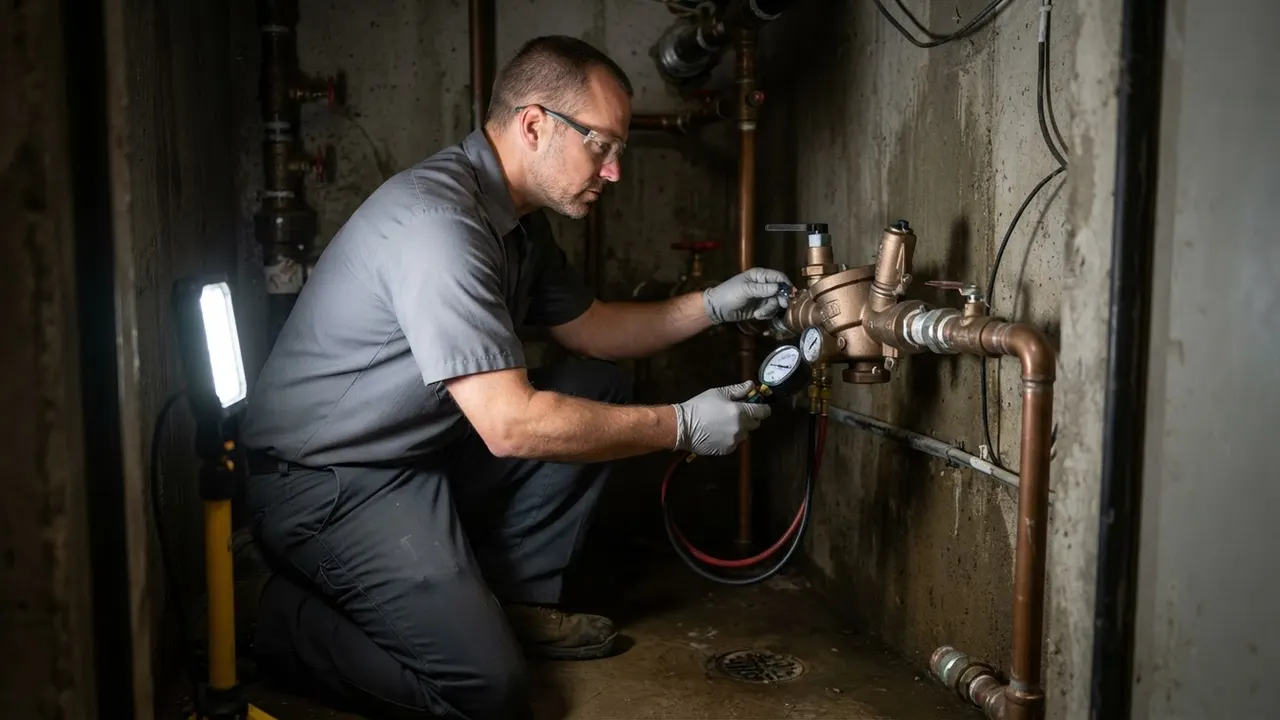
Your backflow preventer is leaking because one of its internal seals, check valves, or the relief valve has failed. In Utah, the most common culprits are freeze damage from a hard winter, debris stuck in a check valve, or a worn-out rubber disc that finally gave out after years of service. The fix ranges from a simple $150 part swap to a $600 full rebuild, depending on the assembly type and how long the leak has been running. This article walks you through the causes, how to pinpoint the source, what repair costs look like in 2026, and when it's time to call a certified tester.
Why is my backflow preventer leaking water in Utah?
A backflow preventer leaking water in Utah is almost always a sign that a rubber component inside the assembly has degraded or that water has frozen inside the body. Utah's climate swings from 100°F summers in St. George to sub-zero nights in Logan, and that temperature range is brutal on rubber diaphragms and seals. The assembly sits outside or in an unheated vault for most residential irrigation systems, so it takes the full brunt of every season.
Backflow preventer leaking water in Utah is a plumbing issue that occurs when the assembly's internal check valves or relief valve fail to seal properly, allowing water to escape instead of flowing through the system. It's not a cosmetic problem. A steady drip can waste thousands of gallons per month and, more importantly, it means the assembly is no longer protecting your drinking water from contamination.
We see this every week across the Wasatch Front. Homeowners in Backflow Testing in Salt Lake City deal with hard water scale that chews through rubber seats, while folks up in Backflow Testing in Logan fight freeze damage every February. The cause is usually obvious once we open the assembly, but the symptoms can look confusing from the outside.
The most common causes of a leaking backflow assembly in Utah
When a leaking backflow assembly in Utah comes across our bench, it's one of six things. Here's what we find, ranked by frequency.
1. Failed check valve seals
The check valves are the heart of the assembly. Each one has a rubber disc or poppet that seals against a seat. After 3-5 years of Utah's hard water, those rubber discs get brittle, crack, or develop a groove where they meet the seat. Once that seal fails, water slips past and either drips from the test cocks or backs up into the relief valve.
2. Worn relief valve diaphragm
On an RPZ (reduced pressure principle) assembly, the relief valve is designed to dump water if the differential pressure changes. The diaphragm inside that relief valve is under constant stress. When it tears, you get a steady stream from the relief port - often the most dramatic leak homeowners see.
3. Freeze damage
Utah winters crack more backflow assemblies than any other single cause. Water trapped inside the body expands when it freezes and splits the brass housing, cracks the bonnet, or pushes the relief valve out of alignment. If your assembly was not winterized properly last fall, this is the first thing we check.
4. Debris stuck in the seat
A small rock, a piece of mulch, or a chunk of mineral scale can lodge between the check valve and its seat. The valve can't close all the way, so water trickles through constantly. This is common on irrigation systems where the assembly sits downstream of a dirty filter or a poorly maintained mainline.
5. Loose fittings or cracked housing
Vibration from the irrigation pump, thermal expansion, or a bad install can loosen the threaded connections on the assembly. Less often, the brass body itself cracks - usually from freeze damage or from over-tightening during a previous repair.
6. Old age
Rubber has a shelf life. Even a well-maintained assembly will need a rebuild kit every 5-7 years in Utah's climate. If your unit is older than that and leaking, a rebuild is the right call.
How to tell where the leak is coming from
Where the water exits the assembly tells you which component failed. Here's how we narrow it down in the field.
- Leaking from the relief valve port (RPZ only): The relief valve is dumping. This points to a failed check valve, a torn relief diaphragm, or a pressure differential problem. On an RPZ leaking water in Utah, this is the most common leak point.
- Leaking from a test cock: The test cock itself may be loose or its internal seal may be shot. Sometimes it's just a bad O-ring, but it can also mean a check valve is passing.
- Leaking from the bonnet or cap: The bonnet gasket has failed, or the cap is not tight. This is often a simple fix.
- Leaking from a threaded connection: The joint needs to be re-taped and re-tightened. If the leak is at the union, it's usually a bad O-ring.
- Water spraying from the body: The housing is cracked. This is a freeze damage signature and usually means a full assembly replacement.
If you have a double check valve leaking Utah homeowners often describe as a "constant drip from the bottom," that's usually the #1 check valve seat. On a double check, there's no relief valve to dump water, so the leak shows up at the lowest point.
Backflow preventer leaking after annual test in Utah
A backflow preventer leaking after an annual test in Utah is surprisingly common, and it's usually not the tester's fault. During the test, we open and close the test cocks and sometimes manually trip the relief valve. If the rubber seals were already marginal, that movement can push them over the edge. A few drips right after a test often stop on their own within a day as the seals reseat. If the leak continues past 24 hours, a seal has failed and needs replacement.
We always note pre-existing wear on the test report. If your assembly was already weeping before the test, the test just made it obvious. The good news is that a rebuild kit is inexpensive and we can usually do it during the same visit.
When to call a professional
Call a professional when the leak is from the relief valve, when water is spraying from the body, or when you've already tried tightening the test cocks and the drip continues. Backflow assemblies are code-regulated devices. In Utah, only a certified backflow assembly tester can legally repair and re-certify them. If you open the assembly yourself and damage a check valve, you'll fail your next inspection and could face a fine from your water purveyor.
Our team at Utah Backflow Specialists handles Backflow Prevention Assembly Testing in Utah and repairs on every major assembly type. We carry rebuild kits for RPZ, DCVA, PVB, and SVB assemblies on our trucks, so most leaks are fixed in a single visit. If you're in Backflow Testing in West Jordan or anywhere along the Wasatch Front, we can usually get to you within 24-48 hours.
What to watch out for
Don't ignore a slow drip. A backflow preventer leaking water in Utah can go from a minor annoyance to a flooded vault or a contaminated water supply in a matter of weeks. Here are the mistakes we see most often.
- Turning the water off and forgetting about it. If you shut off the main to stop the leak, you also shut off your irrigation or fire sprinkler system. That's fine temporarily, but it doesn't fix the assembly.
- Using the wrong rebuild kit. Every assembly has a model-specific kit. A generic O-ring from the hardware store will fail within months.
- Over-tightening the test cocks. This cracks the brass and turns a $20 fix into a $400 replacement.
- Ignoring the annual test. Most Utah water districts require an annual test. A leaking assembly will fail, and you'll pay a re-test fee on top of the repair.
- Letting a leak run through the winter. Water in the assembly freezes and cracks the housing. A $150 rebuild becomes a $600 replacement.
How much does backflow preventer leak repair cost in Utah?
Typical 2026 pricing for backflow preventer leak repair in Utah runs $150-$350 for a rebuild kit and labor on a standard residential assembly. If the housing is cracked or the assembly is obsolete, a full replacement runs $400-$900 depending on the type and size. RPZ assemblies cost more to repair than double check valves because they have more internal parts. Fire sprinkler backflow assemblies and commercial units can run $800-$1,500 for a replacement.
We charge a flat diagnostic fee that we waive if you approve the repair. Most residential repairs take 1-2 hours. If you need a new assembly, we can usually source it same-day from a local supplier.
Frequently Asked Questions
Why is my backflow preventer leaking water in Utah?
The most common reasons are a failed check valve seal, a torn relief valve diaphragm, freeze damage, or debris stuck in the seat. Utah's hard water and cold winters accelerate rubber degradation, so most leaks show up after 3-7 years of service.
Can a leaking backflow preventer fail a Utah test?
Yes. A leaking assembly will almost always fail the annual test because the check valves can't hold pressure. Even a slow drip means a seal is compromised. You'll need to repair the assembly and then re-test it before your water district will accept the certification.
How much does backflow preventer leak repair cost in Utah?
In 2026, expect $150-$350 for a standard residential rebuild and $400-$900 for a full replacement. RPZ and fire sprinkler assemblies cost more. The price depends on the assembly type, the parts needed, and whether the housing is damaged.
Should I turn off water if my backflow preventer is leaking in Utah?
Yes, turn off the water at the isolation valve if the leak is steady or spraying. That stops the water waste and prevents further damage. A slow drip can wait until your technician arrives, but a steady stream should be shut off immediately.
How long does a backflow preventer repair take?
Most residential repairs take 1-2 hours. If we need to replace the entire assembly, plan for 2-3 hours. We carry common rebuild kits on our trucks, so we can usually finish the same day.
Get help with Backflow Testing in Utah
If your backflow preventer is leaking, don't wait for the next freeze or the next test notice. We'll diagnose the leak, repair the assembly, and re-certify it so you're compliant with your water district. Call Utah Backflow Specialists at 555 123456 to schedule a same-week repair.