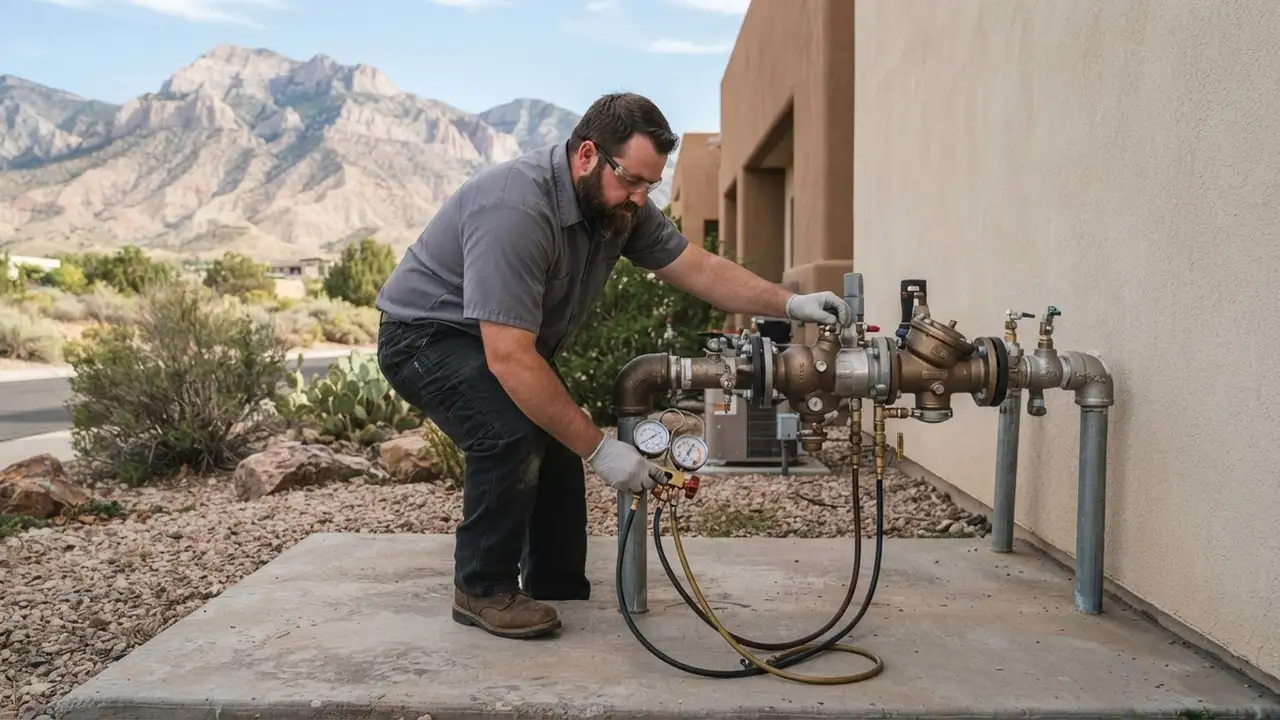
Winterizing your backflow preventer in St. George and southern Utah means draining the assembly, shutting off the irrigation supply, and protecting the test cocks before the first hard freeze - usually by mid-November. If you skip it, trapped water expands inside the brass body and splits the valve, the bonnet, or the check assembly, and that repair runs $180 to $450 in parts alone. This guide covers exactly when to winterize, how to do it step by step, what freeze damage looks like, and how it affects your annual testing schedule.
Why winterizing your backflow preventer in St. George and southern Utah matters
St. George backflow preventer winterization matters because southern Utah gets cold enough to freeze exposed brass even though our winters are mild compared to Salt Lake City. Washington County regularly drops into the low 20s and teens between December and February, and a single 26°F night is enough to crack a wet RPZ or PVB assembly that's still charged with irrigation water.
Backflow preventers sit above ground, usually on a riser next to the meter or at the edge of the lawn. There's no soil insulation, no heat tape, and no building envelope protecting them. Water trapped in the check body, the relief valve port, or the test cock threads has nowhere to go when it expands. Brass doesn't flex - it splits.
We see the same three failures every spring across Backflow Testing in St. George: cracked RPZ relief valve bonnets, split PVB canopies, and shattered test cock nipples. Each one turns a 20-minute winterization into a repair call plus a re-test, and the assembly has to come out of service until parts arrive.
When to winterize irrigation backflow in southern Utah
Winterize irrigation backflow in southern Utah between late October and mid-November, before the first overnight low hits 28°F. In St. George, that first freeze typically lands somewhere between November 10 and November 25 - but we've seen it as early as Halloween in outlying areas like Ivins, Santa Clara, and Dammeron Valley.
Don't wait for the forecast to show a freeze warning. The ground is already cooling by early November, and irrigation lines hold water long after you stop running the sprinklers. Here's the timing we recommend to our customers:
- Late October: final irrigation cycle, then shut off the supply valve inside the house or at the meter.
- First week of November: drain the assembly, blow out the zone lines, and open the test cocks.
- Mid-November: confirm everything is dry and the ball valves are half-open so any residual moisture can escape.
If you're in a higher-elevation pocket - Pine Valley, New Harmony, or the benches above Hurricane - move that schedule up by two weeks. Those areas see 15°F nights while St. George is still in the 30s.
How do I winterize my backflow preventer in St. George Utah?
To winterize your backflow preventer in St. George Utah, shut off the irrigation supply, drain the assembly from the lowest point, open all test cocks and ball valves halfway, and leave the assembly dry until spring. The whole job takes about 20 minutes on a standard 1-inch PVB or RPZ.
Here's the step-by-step we walk homeowners through:
- Shut off the water supply. Find the irrigation shutoff - usually a ball valve inside the mechanical room, in a basement vault, or at the meter box. Turn it fully clockwise.
- Open the drain. Most assemblies have a drain port or a test cock at the lowest point. Open it and let the water run out. If nothing comes out, the line is already drained or the valve is stuck.
- Open the test cocks. There are typically four on an RPZ and two on a PVB. Open each one a quarter-turn so any trapped water can weep out. Leave them open all winter.
- Open the ball valves halfway. This lets air circulate through the body and prevents a pressure seal that traps moisture.
- Blow out the irrigation zones. If you have a compressor, 50 PSI is enough to push water out of the lateral lines. Don't exceed 80 PSI or you'll damage the sprinkler heads.
- Insulate if you can't drain. If your assembly sits in a spot you can't fully drain, wrap it with foam pipe insulation and a waterproof cover. That's a backup, not a substitute for draining.
If your assembly is a Reduced Pressure Principle Assembly RPZ Testing in Utah unit, pay extra attention to the relief valve port - that's the first place water pools and the first thing to crack. PVB assemblies are simpler but the canopy is thin brass and splits easily.
Can a backflow preventer freeze in southern Utah?
Yes - a backflow preventer can freeze in southern Utah any time the overnight low drops below 28°F for more than two or three hours. St. George averages 30 to 40 nights below freezing each winter, and exposed brass assemblies have no freeze protection unless you add it.
The damage isn't always obvious the morning after. A hairline crack in the bonnet may not leak until the ice thaws and water pressure returns. That's why we tell homeowners to check their assembly in February and again in March, before the spring irrigation startup.
Signs your assembly froze over the winter:
- Water pooling under the assembly when you turn the supply back on.
- A visible crack or split in the brass body, bonnet, or canopy.
- Test cocks that won't turn or snap off when you try.
- The relief valve on an RPZ discharging continuously.
Any of those means the assembly needs repair before it can be tested or returned to service. A frozen-then-thawed assembly that looks fine can still fail its annual certification because the internal check discs warp.
Common mistakes we see every winter
The most common winterization mistake in southern Utah is assuming St. George is too warm to freeze. It isn't. We've replaced more cracked RPZ bonnets in Washington County than in any other part of the state because homeowners skip winterization entirely.
Other mistakes we fix every spring:
- Closing the test cocks after draining. Trapped air can't escape, and condensation forms inside the body. Leave them open.
- Leaving the irrigation supply valve on. If the valve leaks even slightly, water refills the assembly and freezes.
- Skipping the blowout. The assembly drains, but the zone lines don't. A cracked lateral in February is a $300 repair.
- Wrapping the assembly in a plastic bag. That traps moisture against the brass and makes freeze damage worse. Use breathable foam insulation instead.
- Forgetting the fire sprinkler line. If your home has a Fire Sprinkler System Backflow Testing in Utah assembly, that line stays pressurized year-round and needs heat tape or a heated enclosure - not draining.
What to do if your backflow preventer freezes in Utah
If your backflow preventer freezes in Utah, shut off the water supply immediately and do not try to force the valves open. Thaw it slowly with a hair dryer on low or warm rags - never a torch or open flame - and call a certified tester before you turn the water back on.
Here's the sequence we recommend:
- Close the irrigation shutoff valve.
- Open the nearest hose bib or drain to relieve pressure.
- Thaw gradually from the bottom up. Brass cracks when heated unevenly.
- Once thawed, inspect for cracks, then call us to pressure-test the assembly.
If the body is cracked, the assembly has to be replaced. Most 1-inch RPZ and PVB assemblies run $220 to $480 for the part in 2026, plus labor and a re-certification test. That's why winterizing in November is cheaper than repairing in March.
Does winterizing affect my Utah backflow testing schedule?
Winterizing does not change your Utah backflow testing schedule - annual certification is still required by the state and by your local water purveyor, usually on the same month each year. What changes is when the test can be performed.
Most southern Utah water systems require backflow assemblies to be tested every 12 months. If your assembly is drained and out of service for the winter, you can't test it until the irrigation system is charged again in spring. That's why we schedule Irrigation System Backflow Testing in Utah calls starting in late March and running through May.
If your test deadline falls in December or January, you have two options: test before you winterize in November, or leave the assembly pressurized and add heat tape. We handle both. The important thing is not to let the deadline slide - a lapsed certification can trigger a shutoff notice from the city.
When to call a professional
Call a professional if your assembly is an RPZ, if you've never winterized it before, or if you see any sign of cracking, leaking, or a stuck test cock. RPZ assemblies have internal springs and check discs that are easy to damage if you drain them wrong, and a botched winterization costs more than the service call.
Utah Backflow Specialists handles winterization, freeze repair, and spring re-certification across Washington County and the rest of southern Utah. We carry replacement parts for the common RPZ, DCVA, and PVB assemblies on our trucks, so most freeze repairs are done in a single visit. We also handle Residential Backflow Testing in Utah for homeowners who want their annual certification done at the same time as their spring startup.
Frequently Asked Questions
How do I winterize my backflow preventer in St. George Utah?
Shut off the irrigation supply, open the drain and all test cocks, leave the ball valves halfway open, and blow out the zone lines at 50 PSI. The whole job takes about 20 minutes on a standard 1-inch assembly. Leave everything open until spring.
Can a backflow preventer freeze in southern Utah?
Yes. St. George sees 30 to 40 nights below freezing each winter, and exposed brass assemblies freeze at 28°F. A single hard freeze can crack an RPZ bonnet or split a PVB canopy, which costs $180 to $450 to repair.
Does winterizing affect my Utah backflow testing schedule?
No - annual certification is still required every 12 months. But a drained assembly can't be tested until spring, so if your deadline falls in winter, test in November before you winterize or keep the assembly pressurized with heat tape.
What should I do if my backflow preventer freezes in Utah?
Shut off the water supply, open a drain to relieve pressure, and thaw slowly with a hair dryer on low. Never use a torch. Once thawed, call a certified tester to pressure-test the assembly before returning it to service.
How much does backflow preventer freeze repair cost in Utah?
Typical 2026 pricing for freeze repair runs $180 to $450 for parts plus $95 to $175 for labor, depending on the assembly type. A full replacement on a 1-inch RPZ runs $400 to $700 installed, including the re-certification test.
Get help with Backflow Testing in St. George
If you'd rather not crawl around a frozen riser in January, we'll winterize your assembly, tag it, and schedule your spring certification so nothing lapses. Utah Backflow Specialists serves St. George, Washington, Hurricane, Ivins, Santa Clara, and the surrounding southern Utah communities.
Call 555 123456 to book winterization or a spring backflow test.